 跳至内容

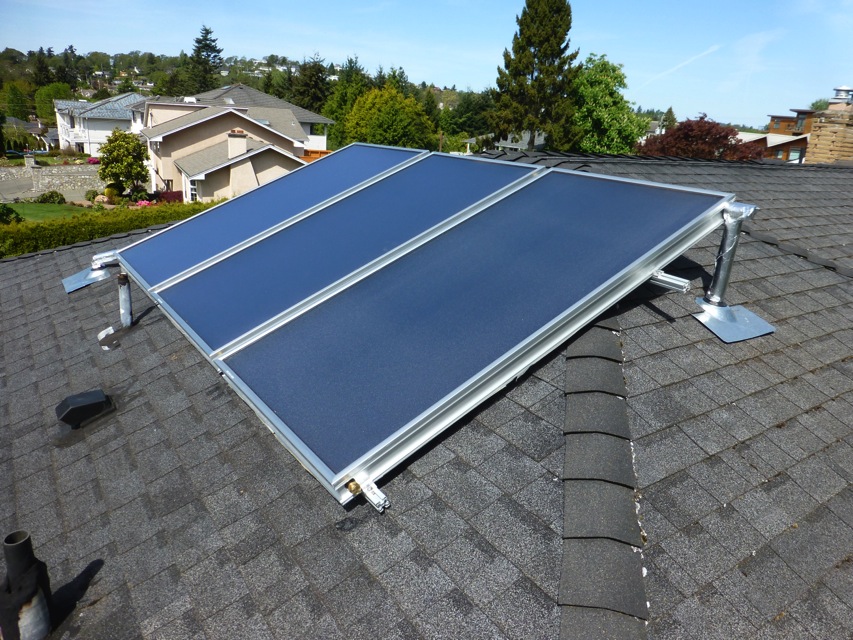
No flat plate collector is perfectly airtight, so moist air gets in. Ventilation holes are how the collector breathes it out again, and their number, position and type decide whether the glass clears in minutes or the absorber coating slowly corrodes.
Short answer: Ventilation holes (breather holes) let humid air leave a solar flat plate collector on sunny days, so moisture does not condense on the inside of the glass and drip onto the absorber. Hole count, position and type all matter. In our January 2024 field tests, a 4-hole collector cleared moisture clearly better than a 2-hole one in calm sunny weather, and in wind the holes on the downwind side drained better than those facing the wind.
Key Takeaways
- A collector cannot be sealed completely, so a small amount of humid air enters over time and can form a water film on the inside of the cover glass.
- Condensate that drips onto the absorber can corrode the coating, and coastal air with salt makes this worse.
- There are three common vent designs: concealed siphon vents, concealed side vents and open side vents. Each trades drying speed, appearance and heat loss differently.
- More ventilation is not automatically better: published research finds that high ventilation can raise moisture input and costs efficiency by letting heat escape in the daytime.
- When you source collectors, ask for the vent layout, the rain-entry design and drying evidence, not only the efficiency curve.
Why Does Condensation Form Inside a Flat Plate Collector?
Condensation forms because humid air gets into the collector and then meets glass that is cooler than the air inside. A flat plate collector is built like a window frame, with sealed edges and a tempered glass cover, but the seal limits air exchange and does not stop it. Over long spells of rain or humid weather, a small amount of moist air passes through tiny gaps into the collector cavity.
That moisture settles first as a thin film of water on the inside of the glass cover. If the film keeps building, it gathers into droplets that fall onto the absorber below. Research on glazed collectors describes the same mechanism: a master’s thesis from Auckland University of Technology notes that at night a collector surface often falls below ambient temperature because it radiates heat to the cold sky, and in humid climates this produces condensation on the glazing. The same work warns that if too much forms on the inside of the glass, it drips onto the absorber and causes long-term damage.
Condensation on the glass is also a performance loss in itself. The moisture has to evaporate the next day before the collector works at full output, which uses solar energy that should have heated water.

Why Is Internal Moisture a Bigger Problem in Coastal and Humid Markets?
Coastal and humid markets are harder on collectors because the air that leaks in carries more water and, near the sea, salt. Moist air that stays inside for a long time sits against the selective coating on the absorber, which is the most valuable part of the collector. Salt and other corrosive particles in coastal air speed up damage to that coating.
The damage shows up as coating discolouration or fading on the absorber. That is a quality failure, not a cosmetic one, because the coating is the part that absorbs the sun. For an importer or brand owner in a humid or coastal region, this is the reason ventilation design belongs on the specification sheet and in the sourcing conversation, next to the pressure rating and the glass.
The practical rule is simple. On sunny days, the moisture and any droplets that have already formed need a route out of the collector. In rain, water must not get a route in. Vent holes are the part of the design that handles both jobs.
What Do Ventilation Holes Do, and Why Is More Not Always Better?
Ventilation holes give humid air a controlled way out on sunny days while the rest of the collector stays rain-tight. They work because heated air inside the collector moves, and cooler outside air comes in through other openings. The standard that governs collector testing expects the same balance: the IEA SHC guide to ISO 9806:2017 states in its rain penetration test that collectors may be equipped with ventilation and/or drain holes, but these shall not permit the entry of drifting rain.
- 1Cooler air entersOutside air is drawn in through the bottom vent.
- 2The sun heats the air gapAir under the glass warms and droplets on the glass evaporate.
- 3Humid air leavesWarm, humid air rises and exits through the top vent.
More ventilation does not always mean less condensation. The Auckland thesis, which reviews and models earlier collector research, finds that ventilation helps compared with a fully stagnant collector, but that high ventilation is not always effective. It gives two reasons: high ventilation can raise the moisture input, and it makes it harder to keep the absorber and cover warm. It also notes that uncontrolled ventilation means higher heat loss during the day and so lower collector efficiency, and concludes that the best solution is an appropriate level of ventilation.
Hole position matters as well as size. The thesis also summarises work by Kohl and co-authors (2007) suggesting that ventilation holes on diagonally opposite corners are more effective than holes dispersed along the edges, and that the effect is clearly reduced when insulation covers the holes. The same summary records that air exchange through a vent reverses direction at night and is roughly half of the daytime volume, which is why the dew point inside the collector matters.
What Are the Three Common Vent Hole Designs?
The three common designs are concealed siphon vents, concealed side vents and open side vents, and they differ mainly in how fast they dry the collector and how much heat they let out. The table summarises what we see in production designs and in our own testing.
| Vent type | How it works | Strength | Trade-off |
|---|---|---|---|
| 1. Concealed siphon vents | Small openings cut into the rubber seal strips above and below the glass. When the sun heats the air inside, cooler air enters at the bottom vents and warm humid air rises out of the top vents, circulating on its own. | Hidden, so the appearance of the collector is not affected. Not affected by wind direction in our test. | The airflow is driven by heat, so it works best in good sunshine. |
| 2. Concealed side vents | Vent openings placed on the sides of the frame, designed to stay out of sight. | Keeps the clean appearance. | Drying effect is weaker than the other two types. |
| 3. Open side vents | Larger side openings with a special rubber vent structure that lets air pass freely. With wind, air flows through the collector and carries humid air out quickly. | Strongest drying effect, especially in wind. | Air also moves in and out easily, so the heat loss coefficient is higher and thermal efficiency is lower. |
The table reflects our design notes; it is not a ranking of products. The right type depends on climate and on how much appearance and efficiency matter against drying speed.

How Did We Test Vent Hole Designs?
We tested vent designs by setting up four collectors together outdoors and watching how fast moisture cleared from the glass. Photos were taken at the start, after 10 minutes and after 20 minutes, and video was recorded. The collectors were:
- Collector 1#: current design, 2 vent holes.
- Collector 2#: earlier design with concealed siphon vents (type 1 in the table).
- Collector 3#: current design, 4 vent holes.
- Collector 4#: current design, 2 vent holes, with the vents placed on the opposite side to collector 1#. This pair tests whether wind direction changes how well the holes drain.
Two tests were run on separate days: Test 1 on January 7, 2024, in windy conditions, and Test 2 on January 10, 2024, with no wind. These are outdoor observation tests. They compare designs against each other on the same day and do not give laboratory humidity measurements.
What Did the Wind Test Show About Vent Position?
In wind, vent holes on the downwind side drained moisture better than vent holes facing the wind. Test 1 ran at an average of 23.5 °C, sunny to cloudy, with wind force 3–4 blowing from collector 4# towards collector 1#.
- Collectors 1# and 4# both have two vent holes. Collector 4#, whose vents lined up with the wind direction, drained moisture very well. Collector 1#, whose vents faced into the wind, drained noticeably worse.
- Collector 3# (4 vent holes) and collector 4# showed the best moisture removal in this test.
- Collector 2# (concealed siphon vents) was not affected by wind direction.
In conditions with weak sunshine, wind direction affects how a collector with side vents breathes. For installers, that points to a simple field check: look at the prevailing wind on site before deciding how the vent side faces.
What Did the No-Wind Test Show About Hole Count?
With no wind, a collector with 4 vent holes cleared moisture clearly better than one with 2 vent holes. Test 2 ran at an average of 28 °C in clear sunny weather. To keep wind out of the comparison, we swapped the positions of collectors 1# and 4#.
- Collector 3# (4 vent holes) cleared moisture very well, and collector 2# (earlier concealed siphon design) did as well.
- Collectors 1# and 4# (2 vent holes each) performed the same once wind no longer favoured either side.
- Raising the vent count from 2 to 4 gave a clearly better drying result than the 2-hole design.
- Collector 2#, with concealed siphon vents, also dried well in good sunny weather.
| Test | Conditions | What we observed |
|---|---|---|
| Test 1, January 7, 2024 | 23.5 °C average, sunny to cloudy, wind force 3–4, from 4# towards 1# | Downwind vents (4#) drained very well, upwind vents (1#) worse; 4-hole 3# also good; concealed siphon 2# unaffected by wind direction |
| Test 2, January 10, 2024 | 28 °C average, sunny, no wind, positions of 1# and 4# swapped | 4-hole 3# and concealed siphon 2# cleared very well; the two 2-hole collectors performed alike; 4 holes clearly better than 2 |
What Do These Tests Not Show?
These tests show how designs rank against each other on a given day, not how many hours a collector needs to dry or how much heat each design loses. We recorded photographs and video at the start, 10 minutes and 20 minutes, but we did not log humidity inside the collector, so we do not publish drying times or percentages. Each test was one day, at one location, in January.
Two points are also open. First, the open side vent design is known to lose more heat, but we have not published a measured efficiency penalty for it, so we do not quote one. Second, a collector with more holes needs the rain-entry check described above: extra holes only help if they stay rain-tight. Buyers who need a number should ask for a test on the exact model, in the climate it will serve.
What Else Keeps Moisture Out of a Collector?
Vents are one tool, and sealing, glazing and the build of the collector all affect internal moisture. The same thesis finds in its simulations that the most effective single factor for reducing condensation on the cover was a low-emissivity glass coating, because it cuts thermal radiation to the sky at night, and that a steeper collector slope slightly reduced condensation frequency.
A very different route is the sealed collector with a breather tube. A 1976 patent assigned to PPG Industries, US 3,990,429, Solar heat collector having a breather tube, describes a capillary tube that connects the collector airspace to ambient air through a desiccant, so pressure equalises without moisture moving into the airspace. It is a reminder that the aim is not just vent holes: it is controlling how much humid air enters and where it can leave.
For flat plate collectors built for water heating, the vent holes plus a well-made seal are the practical answer. Our standard black and blue flat plate collectors use EPDM and silicone sealing, and an aluminium alloy 6063 frame holds a 3.2 mm low-iron patterned tempered glass cover. Good sealing keeps the amount of humid air small, and the vents clear what does get in.
How Should Buyers Evaluate Vent Design When Sourcing Collectors?
Buyers should ask for the vent layout, the rain-entry design and the drying evidence for the exact collector model, because these are rarely on the datasheet. Use the checklist below with every supplier you compare.
| Question to ask | Why it matters |
|---|---|
| How many vent holes, and where are they? | Count and position change drying speed. Two diagonally opposite holes are reported to work better than the same holes spread along the edges. |
| Which vent type is it: siphon, concealed side or open side? | Open vents dry faster but lose more heat; concealed vents keep appearance and efficiency. |
| Do the vents keep out drifting rain? | ISO 9806 expects ventilation and drain holes not to let drifting rain in. |
| Is there photo or video evidence of drying on this model? | A same-day comparison with a reference collector is more useful than a general claim. |
| Do the vents depend on wind direction? | Our test showed downwind vents draining better than upwind vents on the same 2-hole design. |
| What is your climate and distance from the sea? | Coastal and high-humidity markets need more attention to moisture and absorber coating. |
Installers have a short list too: keep vent openings clear of dirt and sealant, do not let insulation or mounting parts block them, and treat fog that does not clear after several sunny days as a sign of a sealing problem rather than a need for more holes.
How Millionsun Approaches Collector Ventilation
Millionsun treats collector ventilation as a design question and compares vent layouts in field tests like the two above. We have been a flat plate collector manufacturer in Dongguan, China since 2006, and our black and blue flat plate collectors use a 6063 aluminium alloy frame, EPDM and silicone seals, low-iron patterned tempered glass of 3.2 mm with at least 92% transmission, and 30 mm glass wool insulation.
Every collector is pressure tested at 100%, and each collector carries a unique serial number tied to batch, production date and QC records. The company’s flat plate collectors have held Solar Keymark since 2008, and our flat plate collector range is available as complete units, SKD, CKD or components. See the collector quality control checklist for what else to check at the factory.
Need collectors built for humid or coastal markets?
Millionsun is a source factory in Dongguan, China, producing flat plate collectors, solar water tanks and system accessories since 2006. We supply complete units, SKD, CKD or components, with OEM and ODM options for logo, labels, packaging, coating colour, collector size and technical documentation. Tell us your climate and volume, and we will explain the vent design and suggest a range.
Request a QuoteFrequently Asked Questions
Why is there water inside my solar flat plate collector?
Water inside a solar flat plate collector is usually condensation from humid air that entered through small gaps and settled on the cooler glass. It normally clears on sunny days through the vent holes. If it stays for many sunny days, check the seals and drain paths, because a leak or a damaged gasket lets in liquid water.
Do solar collectors need ventilation holes?
Yes, solar flat plate collectors need ventilation holes because no collector is perfectly airtight and the moisture that gets in needs a way out. The holes must be placed and sized so that they clear humid air without letting rain in, which is what ISO 9806 expects of ventilation and drain holes.
Are more ventilation holes always better?
No, more ventilation holes are not always better, because high ventilation can increase moisture input and lets heat escape in the daytime. In our calm-weather test a 4-hole collector dried clearly better than a 2-hole one, but the benefit depends on vent position, wind and the climate.
Does wind direction affect how a collector drains moisture?
Wind direction can affect drainage for collectors with side vents, because air pushed through the vents carries humid air out more quickly on the downwind side. In our test, a 2-hole collector with vents on the downwind side drained very well while an identical collector facing the wind drained worse. Concealed siphon vents were not affected.
Can condensation damage the absorber coating?
Yes, condensation can damage the absorber coating when droplets form on the glass, drip onto the absorber and stay there. Coastal air with salt speeds up the damage, and the result is coating fading and loss of performance. Good sealing and well-placed vents are the preventive measures.
Bottom Line
- Collectors breathe: a sealed-looking collector still takes in humid air, and vent holes are how it leaves.
- Condensate dripping on the absorber damages the coating, most of all in coastal and humid markets.
- Hole count, position and type change drying speed, heat loss and appearance, so specify all three.
- In our January 2024 tests, 4 holes beat 2 holes in calm sun, and downwind vents drained better than upwind vents.
- Ask suppliers for vent layout, rain-entry design and drying evidence on the exact model you will buy.