 跳至内容

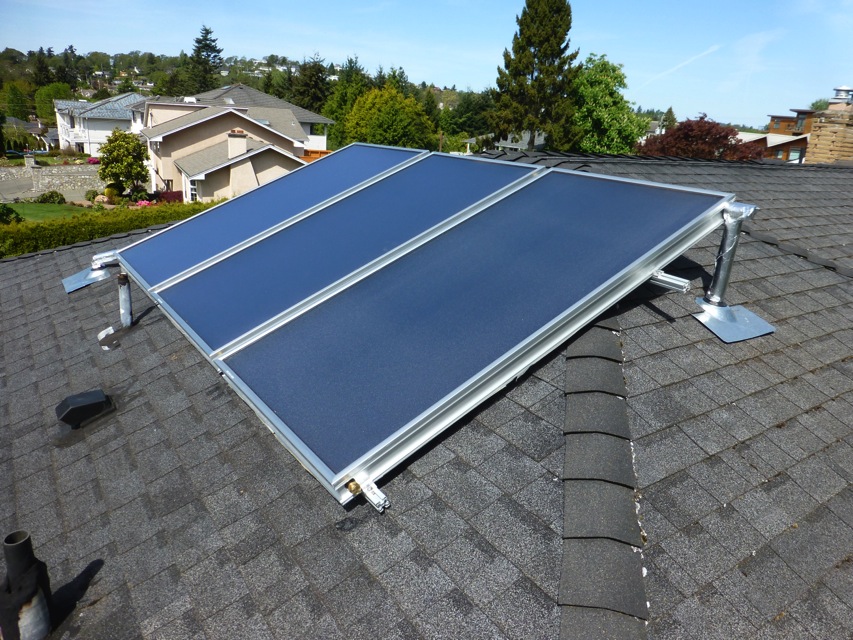
A close-coupled thermosyphon heater has no pump, no controller and one roof-mounted unit, which makes it the simplest solar water heater to ship and install. It also has hard limits on climate, roof structure and water quality. This guide sets them out before you stock the model.
Short answer: A close-coupled thermosyphon solar water heater mounts the storage tank directly above or beside the flat plate collector so that heated water rises into the tank by natural convection, with no pump or controller. It suits warm, frost-free markets with a sound roof, and it needs an indirect (closed-loop) design or a different system type where freezing occurs. Check four things before you stock it: climate, roof load, water quality and backup heating.
Key Takeaways
- Thermosyphon systems run on natural convection, so the tank must sit higher than the collector top and the unit must be mounted level and at the right tilt.
- Direct (open-loop) units belong in frost-free climates; freezing markets need an indirect design or a split system.
- Roof load equals the system weight plus the water it holds, and 1 litre of water weighs 1 kg.
- Hard water and wind loads decide the tank material, the anchoring and the service plan more than the catalogue does.
How Does a Close-Coupled Thermosyphon Solar Water Heater Work?
A close-coupled thermosyphon system heats water by natural convection: sun-heated water in the collector becomes lighter, rises into the storage tank above it, and cooler water from the tank base flows down to replace it. The U.S. Department of Energy describes thermosiphon solar water heating as a passive system that relies on natural convection, and says these simple systems are appropriate for warmer coastal climates.
The layout has three parts that matter to a buyer:
- Collector: usually one to three flat plate collectors. Millionsun’s thermosyphon range covers tank sizes from 150 L to 400 L.
- Tank: a horizontal tank mounted on the same frame, with its base above the collector top so that circulation starts without a pump.
- Frame: an aluminium alloy stand with an adjustable tilt in the range of 15° to 60°, set to suit the latitude.
Because there is no pump or controller, there is little to fail or program. The trade-off is that performance depends on the layout, the tilt and a clean collector, and the system cannot be tuned after installation the way a pumped split system can. Our comparison of thermosyphon and split systems sets out when each makes sense.
Which Climates Suit Thermosyphon Solar Water Heaters?
Thermosyphon systems suit frost-free and mild climates, because the collector and the tank sit outdoors and the water in them can freeze. The U.S. Department of Energy limits the description of these systems to warmer coastal climates. Treat that as a warning when you plan stock for a country with cold inland regions.
| Market condition | Thermosyphon fit | What to specify or consider |
|---|---|---|
| Frost-free, hot and sunny | Good fit | Direct (open-loop) system is acceptable; plan for scale and over-temperature |
| Occasional light frost | Possible with protection | Indirect (closed-loop) heat exchanger tank with antifreeze, or freeze-protection valves; confirm with the supplier |
| Regular freezing | Poor fit | Use a split system with the tank indoors and an antifreeze loop; see our split system guide |
| High wind or cyclone zone | Fit with engineering | Anchoring points, frame rating and strap down details need to be specified |
| Hard or saline water | Depends on the tank | Choose inner tank material and add a heat exchanger or water treatment where needed |
Where a heat exchanger is used, the solar loop carries an antifreeze mixture, and the stagnation temperature of the collector must be inside what the fluid can tolerate. Millionsun’s black and blue flat plate collectors have a maximum idle temperature of 152 °C; see the black flat plate collector page for the full specification.

How Do You Check Roof Load for a Thermosyphon System?
The roof must carry the system weight plus the weight of the water it holds plus wind uplift, and the water is usually the largest part. One litre of water weighs one kilogram, so a 300 L tank adds about 300 kg when full.
Millionsun’s product page lists system weights of 120 kg, 150 kg, 190 kg and 240 kg for the 150 L, 200 L, 300 L and 400 L models. Confirm with the supplier whether a listed weight is empty or filled, then work out the loaded weight as follows:
- Take the dry system weight from the datasheet, including collectors, tank and frame.
- Add the water at 1 kg per litre of tank volume plus the collector and pipe volume.
- Find the footprint and the support points. The load is carried through the feet, so check the spacing against rafters or beams.
- Add wind uplift. A tilted collector acts like a sail; use the local wind speed and code to size the anchors.
- Ask a structural engineer to approve the roof for any project that is not a standard tiled or metal roof in good condition.
Mounting hardware changes with the roof type. Pitched tile, corrugated metal and flat concrete roofs each need a different bracket and sealing method. Our solar thermal accessories include the stands and fittings used with the range.
What Tank and Collector Specification Should You Check?
Check the tank material, pressure rating, insulation and the collector specification as a set, because the tank sits outdoors and the collector sets the stagnation conditions. Millionsun’s smaller tanks use a SUS304 or SUS316L stainless inner tank of 1.5 mm, a galvanized steel outer shell with UV coating, 50 mm polyurethane insulation and a G 3/4″ male connection. They are rated for 0.7 MPa working pressure with a 1.2 MPa test pressure, and a temperature-pressure relief valve and air valve are fitted.
- Pressure rating: match the tank rating to the mains pressure at your destination, and fit a pressure reducing valve where the supply is higher.
- Collector: Millionsun collectors operate at 12 bar and are tested at 20 bar, with 3.2 mm low-iron tempered glass of at least 92% transmission.
- Backup heating: an electric element is optional; confirm the power rating and voltage for your market (220 V or 110 V) in the quotation.
- Heat exchanger: a copper coil is available as an option on request for indirect operation.
- Hard water: request a water analysis and decide if the inner tank grade is suitable. Our guide to enamel and stainless steel solar tanks covers the choice.
What Should a Distributor Stock and Plan For?
A distributor should stock the two or three most-sold tank sizes, the matching mounting kits, and the common wear parts, then add models by market feedback. Thermosyphon units sell in sizes rather than configurations, so the range stays short.
- Sizes: start with 150 L, 200 L and 300 L, and add 400 L if hotels or larger households are a target. Match each tank with its collector area.
- Container loading: ask the factory for units per 20GP and 40HQ for each model on its packing list, so freight is quoted on the same basis.
- Spares: keep gasket and seal kits, connector fittings, relief valves and electric elements on the shelf. Factory spare parts are supported for the full product lifespan, with 3–5 working days for seals and fittings.
- Installer training: a one-page checklist for tilt, level, tank height and flushing prevents most call-backs.
- Documents: collect certificate and test report copies for the markets you serve. See our guide to collector certification by market.

What Installation Mistakes Cause Most Thermosyphon Failures?
Most thermosyphon failures come from layout errors, not from the product: the tank too low, the unit not level, long or flat pipe runs, or the wrong mounting for wind. Give installers a short checklist.
- Tank height: the base of the tank must be above the collector top, or flow will be weak.
- Level and tilt: set the tilt to the latitude within the 15°–60° frame range and keep the tank horizontal.
- Pipework: insulate all outdoor pipes and keep runs short; avoid sags that trap air.
- Safety valve: never block or plug the relief valve outlet; pipe it to a safe drain.
- First fill: fill the tank before exposing the collector to the sun to avoid thermal shock on a dry absorber.
- Anchoring: fix the frame to the structure, not to roofing sheet only.
For the yearly service of any solar hot water system, see our guide to commercial solar hot water maintenance, which also applies to most checks for a domestic unit.
How Millionsun Supplies Thermosyphon Systems
Millionsun is a source factory in Dongguan, Guangdong, producing flat plate collectors and solar water tanks since 2006 on an 8,000 m² site with more than 80 employees and 6 automated production lines. Collector capacity is 20,000 m² per month and tank capacity is 4,000 units per month, and every collector and every tank is 100% pressure tested before shipment.
The thermosyphon system range covers 150 L to 400 L, with OEM and ODM options for logo, labels, packaging, coating colour, collector and tank size and technical documentation. Systems are supplied complete, as SKD or CKD kits, or as components. Samples start at 1–2 units, and we reply within 24 hours. For distribution terms see our page for distributors and importers, and for fitting and service see the installers page.
Looking for a thermosyphon system supplier?
Millionsun is a source factory in Dongguan, China, producing flat plate collectors, solar water tanks and complete systems since 2006. We supply complete units, SKD, CKD or components, with OEM and ODM options. Send your climate, water analysis and target tank sizes and we will reply within 24 hours.
Request a QuoteFrequently Asked Questions
Do thermosyphon solar water heaters work in cold climates?
Thermosyphon solar water heaters work best in warm, frost-free climates, and they need an indirect antifreeze design or a different system type where freezing occurs. The U.S. Department of Energy describes these passive systems as appropriate for warmer coastal climates.
Does a thermosyphon system need a pump or controller?
A thermosyphon system does not need a pump or controller, because natural convection moves the water from the collector to the tank. Only the optional electric backup element needs a thermostat and a power supply.
How heavy is a thermosyphon solar water heater on the roof?
The loaded weight of a thermosyphon solar water heater is its system weight plus the water in the tank, at 1 kg per litre. Millionsun lists system weights of 120 kg to 240 kg for 150 L to 400 L models; if that is the empty weight, a full 300 L unit is roughly 490 kg before wind loads are added, so confirm the basis in the quotation.
What is the difference between a thermosyphon and a split solar water heater?
A thermosyphon system has the tank mounted above the collector and circulates by natural convection, while a split system has a separate tank and a pump with a controller. Split systems cost more but allow an indoor tank and freeze protection.
Which tank sizes should a distributor stock first?
A distributor should stock the 150 L, 200 L and 300 L tank sizes first, because these cover most household demand in warm markets. Add 400 L models where demand from larger households or small hotels is proven.
Bottom Line
- Thermosyphon is a warm-climate system; use an indirect design or a split system where freezing occurs.
- Calculate roof load from the system weight plus water, and add wind uplift.
- Decide the tank material from the water analysis before choosing the model.
- Stock a short range of sizes, matching mounting kits and wear parts.