 跳至内容

Solar can heat a greenhouse by day, but the real problem is the night, when the sun is gone and the heat loss is highest. This guide compares solar water, solar air and thermal mass systems, shows how to size storage, and explains when solar needs a backup heater.
Short answer: A solar greenhouse heating system collects heat in the daytime with passive glazing, solar air collectors or solar water collectors, stores it in water, soil or masonry, and releases it at night. Passive design with water thermal mass is the cheapest option for season extension, solar air collectors add daytime heat and dehumidification, and solar water systems with a storage tank can heat benches, soil or floors. Cold-climate greenhouses growing frost-sensitive crops still need a backup heater, because stored solar heat covers only part of a long winter night.
Key Takeaways
- Three solar options exist: passive thermal mass, solar air collectors and solar water collectors with storage.
- The sizing question is night heat loss: store enough heat to cover the night, or add backup heating.
- Water is the standard thermal mass, but it is heavy, since a 55-gallon barrel weighs more than 450 lb when full.
- Solar water collectors suit low-temperature floor and bench heating, so flat plate collectors are a good fit.
Why Is Heating a Greenhouse With Solar Hard?
Heating a greenhouse with solar is hard because the heat is needed at night while the sun supplies it by day, so the system must store heat between the two. A glazed greenhouse gains heat quickly in sunshine and loses it quickly after dark, because the cover has little insulation. The University of Georgia’s Extension bulletin on a passive solar greenhouse lists the roof and end walls as 6 mm twin-wall polycarbonate, with the end walls rated about R-1.6, which is a low value compared with an insulated wall.
The design therefore has three jobs:
- Collect solar heat while the sun is up.
- Store enough heat in a mass that holds temperature through the night.
- Reduce loss with insulation on the north side, double glazing and night curtains where practical.
What Are the Solar Heating Options for a Greenhouse?
The three main solar options are passive thermal mass, solar air heating and solar water heating, and projects often combine two of them. The U.S. Department of Energy’s Solar Vision Study lists heating greenhouses among the emerging agricultural uses of solar heating and cooling, alongside crop drying and heating farm buildings.
| Option | How it works | Strength | Limit |
|---|---|---|---|
| Passive thermal mass | Sun-warmed water barrels, soil or masonry release heat at night | No pumps, no electricity, low cost | Heavy; limited control; needs insulation and a south-facing design |
| Solar air heater | Fan moves greenhouse air through a collector and back | Fast daytime heat; no freezing risk; also dries the air | No night output without stored heat; fan and ducts needed |
| Solar water heating | Collectors heat a tank; pumped loop feeds floor, bench or air heat exchanger | Stores heat in a tank; can heat soil or benches directly | Higher cost; needs freeze protection and a controller |
| Backup heater | Gas, electric or biomass heater on a thermostat | Covers cold nights and cloudy spells | Fuel or electricity cost |
The choice follows the crop, the climate and the budget. A hoop house extending the season in a mild climate can rely on passive mass, while a commercial house growing seedlings in winter usually needs a solar water or air system plus backup heat.
How Does Passive Solar Heating Work in a Greenhouse?
A passive solar greenhouse faces the sun, insulates the cold side and uses a heavy mass to hold daytime heat for the night. In the University of Georgia prototype, the roof and front wall face south, the north wall is covered with two layers of 1.5 in. rigid foam, and the mass is a sand-filled wall on one half and 55-gallon water barrels stacked two high on the other. The bulletin says each barrel weighs more than 450 lb when full, and that the growing-degree-day totals did not differ between the sand and water sections.
The same bulletin reports that the structure kept winter air temperatures higher than nearby double-layer high tunnels and could extend warm-season crops by at least one month. It also warns that summer heat was a problem: the average June to August daily maximum was nearly 20 °F above the open field, so ventilation and shade are part of the design.
How Does Solar Water Heating Work for a Greenhouse?
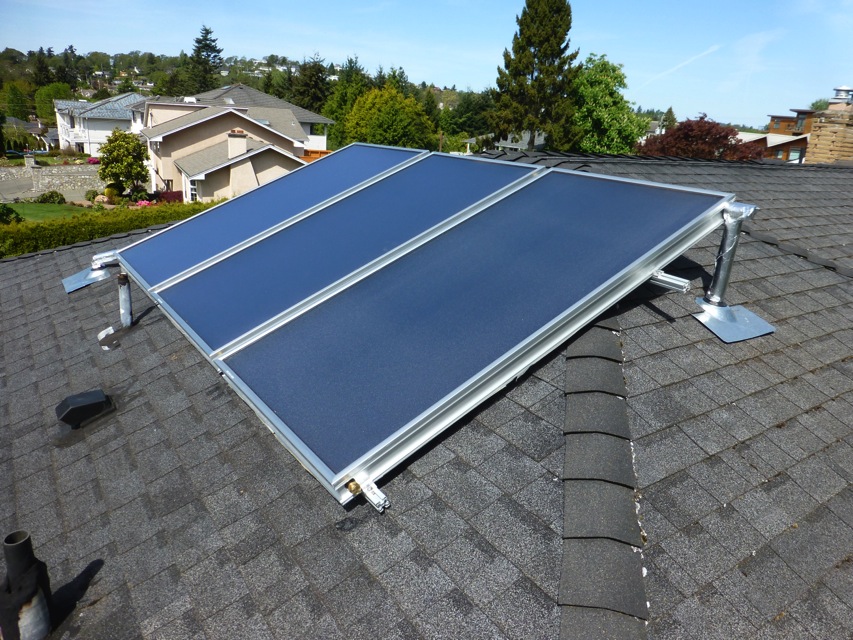
A solar water system heats water in collectors, stores it in a tank and circulates it to benches, soil or floor loops, or through a fan-coil. The Solar Vision Study notes that flat plate collectors suit radiant-floor systems because they perform well at liquid temperatures of 120–140 °F, so a greenhouse floor or bench loop is a natural match for a flat plate collector.
- Collectors: flat plate collectors for low-temperature loops; see our guide to flat plate and evacuated tube collectors.
- Storage tank: an insulated tank that holds the heat until night.
- Distribution: tubing under benches or in the soil, or a fan-coil that blows warm air.
- Controls and protection: a differential controller, and antifreeze or drainback for frost; see solar hot water system types.
The collector-to-tank link works like any solar water system, and the main differences are the low target temperature and the large, steady night demand.
How Does a Solar Air Heater Help a Greenhouse?
A solar air heater adds daytime warmth and removes humidity by blowing greenhouse air through a collector and back into the house. It has no water, so it cannot freeze, and it works well on sunny cold days, but it provides no heat after sunset unless the warm air is also charged into a thermal mass. Our guide to solar air heaters covers the types, sizing and limits in detail.
How Do You Size Storage and Collectors?
Size a greenhouse system from its night heat loss: multiply the area of the cover by its U-value, the inside-to-outside temperature difference and the hours of darkness, then provide that much stored heat. The University of Georgia’s R-1.6 cover is about 3.5 W/m²K, so every square metre of twin-wall polycarbonate loses roughly 3.5 W for each degree of difference.
- Find the night heat loss. Loss (kWh) ≈ cover area (m²) × U (W/m²K) × ΔT (K) × night hours ÷ 1,000.
- Subtract passive gains and insulation savings. Insulated north walls and night curtains reduce the loss.
- Size the storage. Water holds about 1.16 kWh per cubic metre for every kelvin of temperature swing.
- Size the collectors. Divide the heat to be stored by the daily yield per m² of collector for the winter month.
- Add backup. Specify a thermostat-controlled heater for nights when storage runs out.
An illustrative example uses assumed numbers, not market data: a house with 40 m² of cover held at 10 °C when the outside is −5 °C (ΔT 15 K) for 12 hours loses about 40 × 3.5 × 15 × 12 ÷ 1,000 ≈ 25 kWh through the cover alone, before air leakage. Storing 25 kWh in water with a 20 K swing needs about 1.1 m³, or roughly five 55-gallon barrels. The DOE’s Federal Technology Alert on solar water heating gives a clear-day yield of about 3.2 kWh/m² for a glazed flat plate collector with water 20 °C above ambient, which suggests around 8 m² of collector on a clear day and far more on a cloudy one, so confirm with local data and a tested collector.
How Does Solar Compare With Other Greenhouse Heaters?
Solar costs more to install than a gas or electric heater and saves fuel, but it rarely covers the whole winter load in a cold climate. Conventional heaters need ventilation, fuel supply and, for combustion heaters, a carbon monoxide risk assessment, so they belong on a thermostat as a backup rather than as the only source in a sealed house.
- Solar plus thermal mass: lowest running cost, highest design effort.
- Electric or infrared heaters: easy to install and control; running cost depends on the tariff.
- Gas, propane or oil heaters: strong output; need ventilation, flue and fuel storage, and give off moisture.
- Hybrid: solar for daily base load and a thermostat-controlled heater for cold nights.
How Millionsun Supports Greenhouse Heating Projects
Millionsun is a source factory in Dongguan, Guangdong, producing since 2006 on an 8,000 m² site with more than 80 employees and 6 automated production lines. Collector capacity is 20,000 m² per month, tank capacity is 4,000 units per month, and every collector and tank is 100% pressure tested before shipment.
For solar water systems we supply flat plate collectors and solar water tanks, and for air heating we make a solar air collector. Products are supplied as complete units, SKD, CKD or components, with OEM and ODM options. We do not design greenhouse climate systems, so confirm the heat-load calculation with your greenhouse engineer and send us the collector area, storage volume and loop temperatures to quote against.
Planning solar heating for a greenhouse project?
Millionsun is a source factory in Dongguan, China, producing flat plate collectors, solar water tanks, air collectors and complete systems since 2006. We supply complete units, SKD, CKD or components, with OEM and ODM options. Send your collector area, storage volume and loop temperatures and we will reply within 24 hours.
Request a QuoteFrequently Asked Questions
Can you heat a greenhouse with solar energy alone?
You can heat a greenhouse with solar energy alone in mild climates or for season extension, but cold climates need a backup heater for the longest nights. A passive greenhouse with thermal mass extended warm-season crops by about one month in a University of Georgia trial.
What is the best thermal mass for a greenhouse?
Water in black barrels is the most common thermal mass for a greenhouse, because it stores a lot of heat per unit of volume and is cheap. A University of Georgia trial found no difference in growing degree days between water barrels and a sand-filled wall, so choose by cost, weight and space.
How many water barrels does a greenhouse need?
The number of water barrels depends on the night heat loss and the temperature swing you accept, not on a fixed ratio. Calculate the loss, then divide by the heat one barrel can store; in the illustration above, about 25 kWh needs roughly five 55-gallon barrels.
Should a greenhouse solar system use air or water?
Choose solar air for fast daytime heat and dehumidification, and solar water where you want stored heat for floors, benches or soil. Many projects combine both with a thermostat-controlled backup heater.
Bottom Line
- Size the system from night heat loss, and store the heat in water, soil or masonry.
- Use passive mass for low-cost season extension, solar air for daytime heat and solar water for stored heat.
- Add a thermostat-controlled backup heater for cold climates and frost-sensitive crops.