 跳至内容

Hotels use hot water every day of the year, at predictable times, in large volumes. That makes them one of the best commercial fits for flat plate solar water heating, as long as the system is sized to real demand and designed around Legionella control from the start.
Short answer: In a hotel, solar thermal works as a preheat stage. A roof array of flat plate collectors heats a glycol or water loop. A heat exchanger passes that heat into a large storage tank, and the hotel’s existing boiler or heat pump tops the water up to the safe storage temperature of 60°C before it reaches guest rooms. Solar covers the bulk of the daily heating energy on sunny days, and the backup covers peaks and cloudy periods. Design comes down to three numbers: daily hot water demand, the share of it you want from solar, and a storage volume that matches the collector area.
Key Takeaways
- Water heating is a major hotel energy load. The US EIA puts it at about 20% of end-use energy in lodging buildings.
- Size the system from measured or code-based demand. Spain’s building code, for example, uses 41–69 litres per guest per day at 60°C depending on hotel category.
- Solar is a preheat, not a replacement. Keep a backup boiler or heat pump that can take every litre to 60°C.
- Legionella control shapes the hydraulics: store at 60°C or above and deliver at least 50°C at outlets within one minute, as UK HSE guidance requires.
- For commercial arrays, specify pressure-rated collectors, certified test data (Solar Keymark, SRCC or your market’s scheme) and storage designed for the building’s pressure and plant-room space.
How Does Solar Thermal Work for Hotels?
A hotel solar thermal system is a pumped preheat loop: collectors on the roof heat a fluid, and a pump station carries that heat to storage in the plant room before the main water heater. Unlike a small rooftop thermosyphon unit, the array and the tank sit far apart, so the system depends on a pump, a controller and a heat exchanger. Each part has a specific job in a hotel:
| Component | What it does | Hotel-specific point |
|---|---|---|
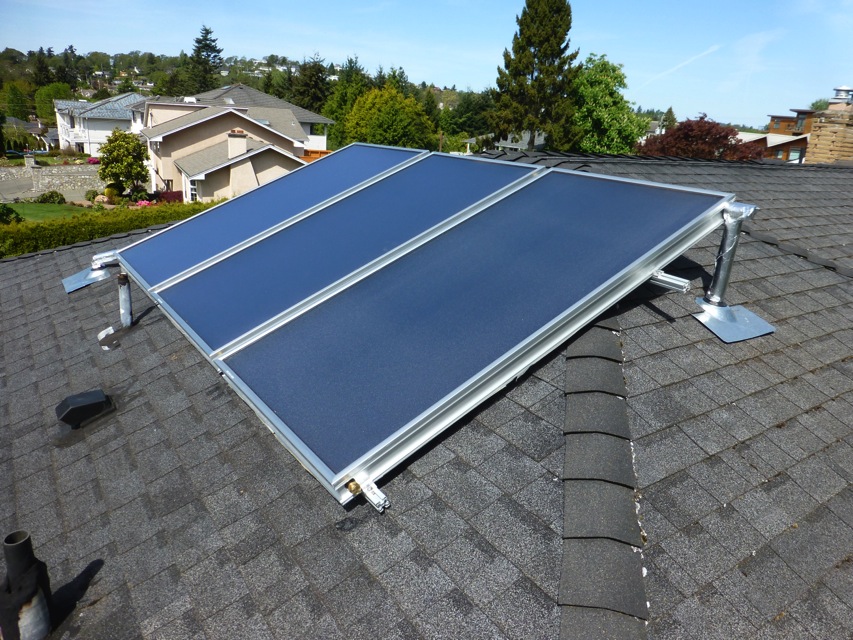
| Flat plate collector array | Absorbs sunlight and heats the solar fluid | Banks of large panels (2.5–3.0 m²) reduce hydraulic connections per square metre |
| Solar loop (glycol or water) | Carries heat from roof to plant room | Closed, pressurised loop; glycol where frost is possible |
| Pump station and controller | Runs the pump when the collectors are hotter than the tank | Logs temperatures and flow so the hotel can verify savings |
| Heat exchanger | Transfers heat from the solar loop to potable water | Internal coil for smaller tanks, external plate exchanger for large arrays |
| Solar preheat storage | Holds the day’s solar heat for evening and morning peaks | Often several thousand litres, pressurised or open-vented |
| Backup heater | Brings water to 60°C when solar falls short | Existing gas boiler, electric heater or heat pump |
| Recirculation loop | Keeps hot water close to every room | Return water temperature is a key Legionella checkpoint |
The backup heater only adds the temperature that solar could not supply, which is where the savings come from. During the day, the controller runs the solar pump whenever the collectors are hotter than the tank. Cold mains water enters the bottom of the solar tank, is preheated, and flows on to the backup heater, which tops it up. The same pumped principle is used in our split solar water heating systems, scaled up for commercial demand.

Why Are Hotels a Good Fit for Solar Water Heating?
Hotels suit solar water heating because hot water is one of their largest energy loads and it is needed every day of the year. According to the US Energy Information Administration’s Commercial Buildings Energy Consumption Survey (2018), water heating and space heating each accounted for about 20% of end-use energy consumption in lodging buildings. A load that large and that steady keeps a solar array working instead of stagnating.
The economics work because hotel demand is daily, predictable and partly aligned with the sunniest season:
- Demand every day. Showers, kitchens and laundries run 365 days a year, so collected heat is almost always used. A school, by contrast, wastes summer yield during holidays.
- Predictable peaks. Guest showers cluster in the morning and evening. Storage bridges the gap between midday collection and these peaks.
- Seasonal overlap in resort markets. In sun-belt and coastal destinations, high occupancy coincides with the strongest solar months.
Commercial users such as hotels are becoming more important to the solar thermal market as residential sales shrink. The International Energy Agency’s Solar Heating and Cooling Programme lists hotels among the main user groups of solar heat in its Solar Heat Worldwide 2025 release. The same report recorded 17.8 GW of new solar heat capacity in 2024 while the global market declined by 14%, which shifts suppliers’ attention to buyers with steady, large demand.
How Much Hot Water Does a Hotel Use?
A hotel guest uses roughly 34–69 litres of 60°C hot water a day, depending on hotel category, according to the reference values in Spain’s Technical Building Code (CTE DB-HE, Annex F, 2022 text). Kitchens and laundries come on top of that. Designers start from per-guest values like these, then adjust for occupancy and extra loads; the Spanish table is a useful public example because it states every value at the same 60°C basis:
A mid-size four-star hotel needs roughly 8,400 litres of 60°C water a day for its guests alone. The calculation: a 120-room four-star hotel at 80% occupancy with an average of 1.6 guests per room has about 154 guests a night, and 154 × 55 litres ≈ 8,400 litres. That figure excludes kitchens and laundries, and the code itself notes that these reference figures must be increased for distribution, storage and recirculation losses.
EPC teams should treat reference tables as a starting point and correct them with site data:
- Use metered data when it exists. An existing hotel’s gas or electricity records, or a few weeks of flow metering, beat any reference table.
- Count non-guest loads separately. Commercial kitchens and in-house laundries can add a large share on top of room demand and often run at different times of day.
How Are Collector Area and Storage Sized for a Hotel?
Hotel systems are sized to a target solar fraction, meaning the share of annual hot water energy that solar supplies, not to cover 100% of demand. Covering every cloudy winter day would need a very large array that overheats and stagnates in summer. Some building codes set the target for you. Spain’s CTE DB-HE 4 requires renewable sources to cover at least 70% of annual hot water demand, reduced to 60% where demand is below 5,000 litres a day.
Sizing runs in a fixed order, from demand to collector area to storage, and ends with an overheating check:
- Fix daily demand in litres at 60°C, including losses and non-guest loads.
- Set the solar fraction from the local code, the client’s budget or the payback target.
- Size the collector area with simulation software using local irradiation, collector tilt and the collector’s certified efficiency curve. Certified test data matters here because the simulation is only as good as the collector parameters you enter.
- Match storage to collector area so the tank can absorb a sunny day’s yield without overheating. National guidelines give storage-to-area ranges; follow the one that applies in your market.
- Check summer overheating. An undersized tank or a low-occupancy season can push the array into stagnation, so plan heat dumping, drain-back or reduced tilt where needed.

Real hotel projects typically cover a large share, but not all, of daily demand with solar. At the 245-room Hilton in Sofia, Bulgaria, 45 flat plate collectors were reported to supply about 5,000 of the hotel’s 8,000 litres of daily hot water demand (solarthermalworld.org, 2013). That is just over 60% of daily demand. Use projects like this as an order of magnitude, not as sizing rules, because climate, tilt and demand profiles differ.
How Does Solar Connect to the Hotel’s Existing Boiler or Heat Pump?
Solar connects to a hotel’s existing plant as a preheat stage in series: cold water passes through the solar storage first, then into the existing water heater, which adds only the remaining temperature lift. This keeps the existing plant in charge of final temperature and safety, and it lets solar be added to a running hotel without replacing the boiler. Four layouts are common:
| Configuration | How it works | When to use it |
|---|---|---|
| Separate solar preheat tank | Solar tank feeds the existing calorifier or boiler-fired tank | Retrofits; large hotels with existing plant rooms |
| Dual-coil tank | Lower coil from solar, upper coil from boiler in one vessel | Smaller hotels and new builds with limited space |
| Solar plus heat pump | Solar preheats; heat pump tops up or charges storage at night | Electrified buildings and sites phasing out gas |
| Multiple tanks in series | Several pressurised tanks linked to reach large volumes | When a single large vessel won’t fit through doors or the plant room |
Solar and a heat pump work well together if the controls give solar priority. Set the heat pump so it doesn’t fully charge the solar tank before the sun has had a chance to, otherwise the collectors have no cold water to heat. Include a bypass so the backup can supply the hotel during solar maintenance.
How Do You Control Legionella in a Hotel Solar Preheat System?
Legionella is controlled in a hotel solar system by making sure every litre reaches 60°C before use and by never letting the preheat tank stay lukewarm for long. It is the design constraint that most often catches solar retrofits out, because preheat tanks can sit for hours between 20 and 45°C, the range the UK Health and Safety Executive identifies as suitable for Legionella growth. The US Centers for Disease Control and Prevention notes that hotels and resorts are frequent settings for outbreaks and that water management programmes are now an industry standard for most US hotels.
UK Health and Safety Executive guidance on hot and cold water systems sets three temperature targets that solar designs must still meet:
- Store hot water at 60°C or higher.
- Distribute it so it reaches at least 50°C at outlets within one minute (55°C in healthcare premises).
- Keep cold water below 20°C.
In practice, the backup heater must always bring the final storage stage to 60°C, and the solar preheat tank needs a regular heat cycle. The preheat tank should be heated to 60°C or above periodically (a pasteurisation cycle), have no dead legs, and drain fully for inspection. Follow your national code where it is stricter, and bring the hotel’s water safety manager into the design review.
Which Collector and Tank Specifications Matter for Hotel Projects?
For a hotel, the specifications that matter most are pressure rating, stagnation behaviour, certified performance data and storage that fits the building. A collector that is fine on a single-family roof may not be the right choice for a 100 m² array on a ten-storey hotel.
| Specification | Why it matters for hotels | Millionsun reference |
|---|---|---|
| Operating and test pressure | Tall buildings and pumped loops run at higher system pressure | 12 bar operating, 20 bar test; every collector pressure-tested |
| Stagnation temperature | Arrays will stagnate during pump failure or low occupancy | 152°C maximum idle temperature |
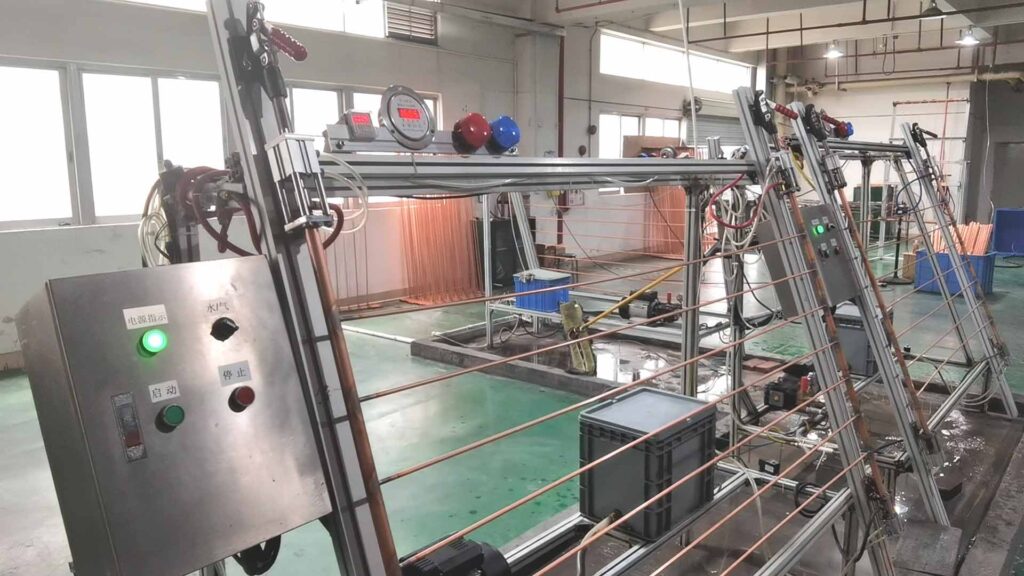
| Cover glass | Hail, wind load and long-term transmittance | 3.2 mm low-iron tempered glass, transmittance ≥92% |
| Panel size | Fewer connections and less frame per m² on large arrays | 1.5–3.0 m² gross; 3.0 m² panel has 2.80 m² aperture |
| Certification | Needed for subsidies, tenders and accurate simulation | Solar Keymark (collectors since 2008); SRCC, WaterMark and AS/NZS 2712 listings since 2011 |
| Storage volume and type | Must hold a day’s yield and fit the plant room and mains pressure | Large tanks from 1,000 L to 5,000 L, custom above; pressurised or open-vented; optional copper coil |
| Traceability | Warranty claims on large projects need batch records | Serial number on every collector linked to production and QC records |
For hotel arrays, the collector certificate matters more than a system certificate, because hotel systems are almost always custom-built. The Solar Keymark scheme covers collectors tested to EN 12975 or ISO 9806, factory-made systems under EN 12976 and custom-built systems under EN 12977. A custom hotel system therefore relies on the collector’s certified test data plus the designer’s calculations. See our certification guide by market for which scheme applies where.
Cold sites need freeze protection designed in from the start, either with heat pipe flat plate collectors or a well-designed glycol loop. For storage, our large capacity solar water tanks are built for commercial preheat duty.
What Should EPC Contractors Check Before Ordering?
Before ordering, EPC contractors should confirm that the supplier can back every design assumption with documents. This checklist covers the points that most often cause delays or disputes on commercial solar hot water projects.
| Check | What to ask for |
|---|---|
| Collector performance data | Certified efficiency parameters (ISO 9806 test report or certificate number) for simulation |
| Pressure ratings | Operating and test pressure for collectors and tanks, matched to the building’s system pressure |
| Storage design | Tank drawings, wall thickness, insulation, connection sizes and whether it fits through the plant-room access |
| Legionella features | Drain points, sensor pockets for pasteurisation control and no dead legs |
| Mounting and wind load | Frame drawings and fixing details for the roof type and local wind zone |
| Quality records | 100% pressure-test records and serial-number traceability |
| Logistics and lead time | Delivery schedule against the construction programme, packing for sea freight and spare parts lead times |
Millionsun supplies EPC contractors with complete collector arrays, large storage tanks and accessories, and ships spare parts within 5–7 working days. For a broader collector sourcing checklist, see the flat plate solar collector buyer’s guide. Our EPC and project developer page covers project support in more detail.
Planning a hotel solar hot water project?
Send us the number of rooms, location, available roof area and existing water heating plant. We’ll reply within 24 hours with suitable collector and tank options, datasheets and certification documents for your market.
Request a QuoteFrequently Asked Questions
Can solar provide all of a hotel’s hot water?
No, solar can’t economically provide all of a hotel’s hot water. Systems are designed for a target share of annual demand, often set by local codes (Spain’s code requires at least 60–70%). A backup boiler or heat pump always covers peaks, cloudy days and the final heating to 60°C.
Is flat plate or evacuated tube better for hotels?
Flat plate collectors suit most hotel projects because they’re pressure-rated, robust and simple to integrate into large arrays. Evacuated tubes can perform better in very cold or diffuse-light climates. Our flat plate vs evacuated tube comparison covers the trade-offs.
Does solar thermal work with a hotel heat pump?
Yes, solar thermal works well with a hotel heat pump: solar preheats the water and the heat pump tops it up. Set the controls so the heat pump doesn’t fully charge the solar tank before sunrise, or solar has no room left to contribute.
What if the hotel roof is too small?
If the hotel roof is too small, install a smaller array at a lower solar fraction rather than dropping solar altogether. Use larger 2.5–3.0 m² panels to reduce frame losses, and consider façade or carport mounting. Even a partial system cuts the boiler’s daytime load.
How much maintenance does a hotel solar system need?
A hotel solar system needs one planned service a year plus ongoing Legionella checks. The annual service covers glycol condition, loop pressure, pump operation, sensor readings and collector glass, and the Legionella checks follow the hotel’s water safety plan. Monitoring data from the controller makes faults visible quickly.
Bottom Line
- Design solar as a preheat stage, with the existing boiler or heat pump finishing every litre at 60°C.
- Size from real demand: metered data first, code reference values second, and count kitchens and laundries separately.
- Target a sensible solar fraction and match storage to collector area so the array doesn’t overheat in summer.
- Specify pressure-rated, certified collectors and storage that fits the plant room, with Legionella control built into the hydraulics.