 跳至内容

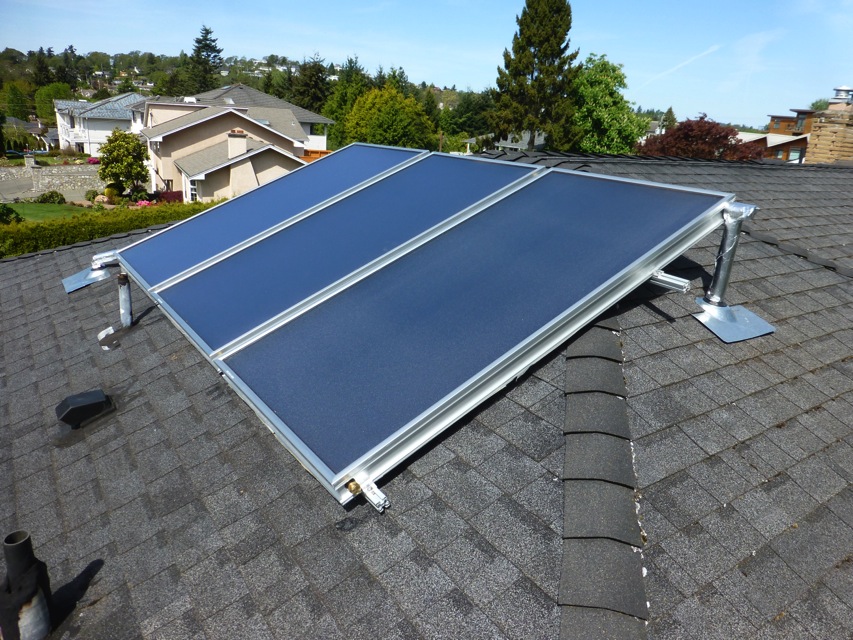
Both systems heat water with the same flat plate collectors. The difference is where the tank sits and what moves the heat, and that single choice decides freeze protection, roof load, spare parts and who can install it.
Short answer: Stock a thermosyphon system for warm markets where freezing is not a risk and roofs can carry a tank, because it has no pump or controller to fail. Stock a split system for markets with frost, for buildings whose roofs cannot carry a tank, and for projects that want the tank indoors. Most distributors with mixed climates end up carrying both, sharing the same collectors and tanks.
Key Takeaways
- A thermosyphon system puts the tank above the collector and needs neither a pump nor a controller; a split system puts the tank anywhere and adds a pump station, controller and expansion vessel.
- Climate decides first: indirect (antifreeze) systems prevail in cold regions, while direct systems are common where freezing is not a risk.
- Fewer parts mean fewer failures and fewer spares for thermosyphon; split systems cost more to install and service but give design freedom.
- Both types can be certified as factory-made systems under EN 12976, so ask for the system test report either way.
What Is the Difference Between a Thermosyphon and a Split Solar Water Heater?
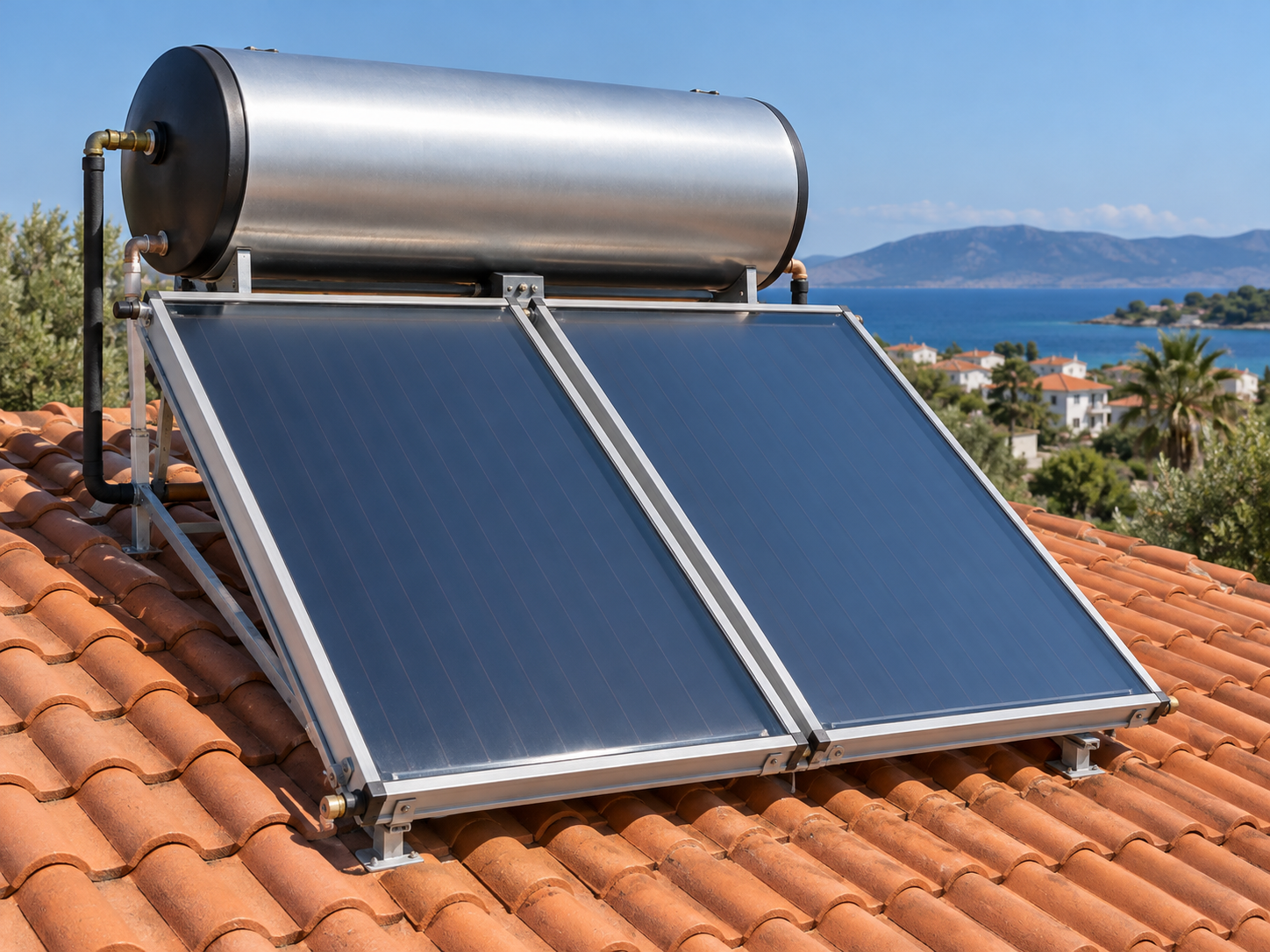
The difference is how the water moves and where the tank sits: a thermosyphon system moves water by gravity with the tank above the collector, while a split system uses a pump and a controller so the tank can be anywhere in the building. Everything else a buyer cares about follows from that one choice.
The Florida Solar Energy Center’s guide, FSEC-EN-9, describes the thermosiphon principle: water in the collector tubes warms and becomes lighter, so gravity pulls colder water down from the tank into the collector inlet and the heated water rises into the top of the tank. The storage tank is mounted above the collector, and the guide states that a thermosiphon system requires neither pump nor controller.
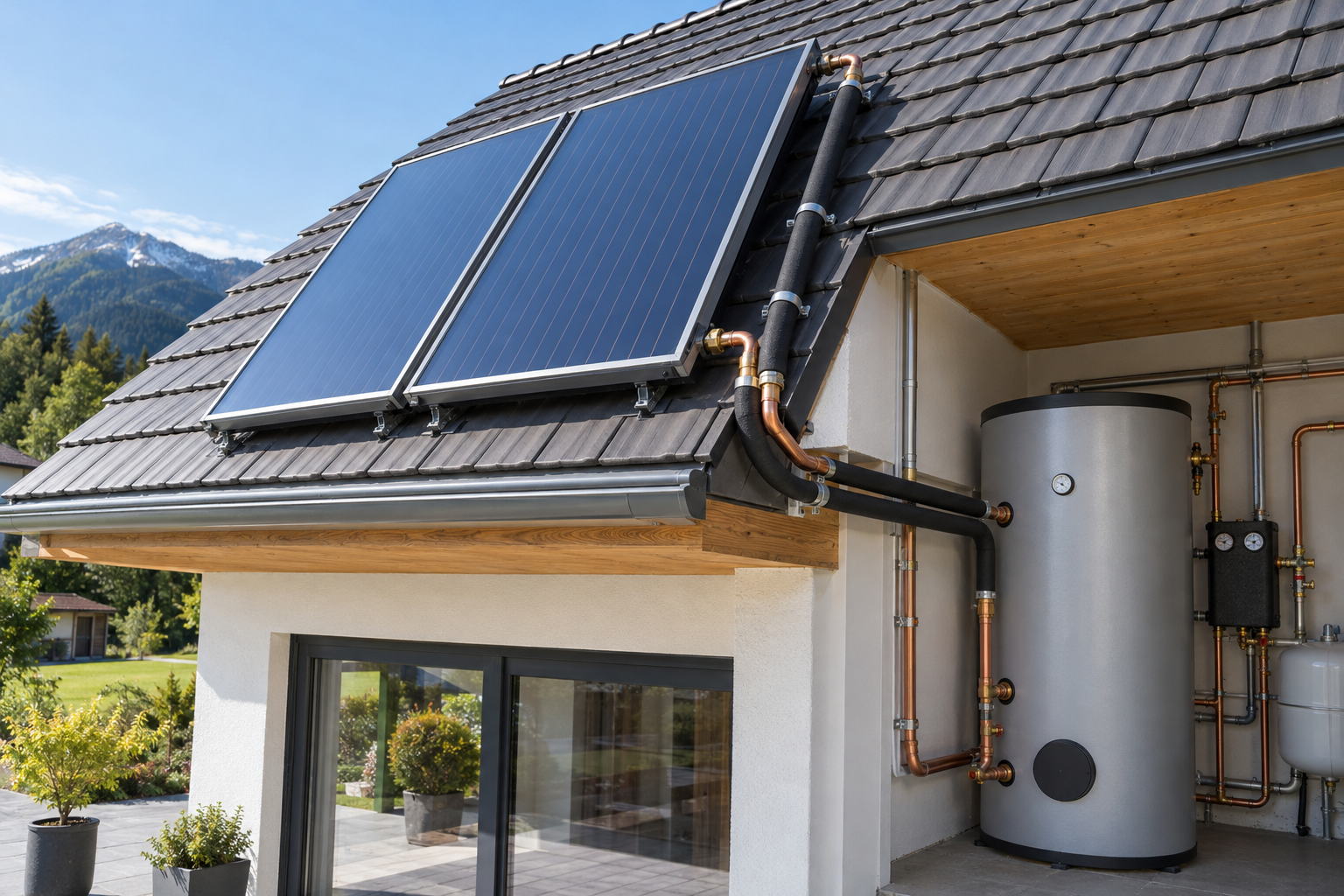
A split system breaks that dependency. A pump moves fluid between collector and tank when a differential controller sees the collector running hotter than the tank, which is why the tank can sit in a plant room, garage or roof void.
| Item | Thermosyphon system | Split (pumped) system |
|---|---|---|
| How heat moves | Gravity: heated water rises into a tank above the collector | Pump and differential controller move fluid between collector and tank |
| Tank position | On the roof, above the collector | Anywhere: indoors, plant room or roof space |
| Moving parts and electronics | None in the solar loop | Pump, controller, sensors |
| Typical loop type | Direct in warm climates, indirect in colder ones | Mostly indirect with antifreeze fluid; drain-back is an option |
| Roof sees | Collectors, tank and filled weight | Collectors and insulated pipes only |
| Install complexity | Lower: one assembly on the roof | Higher: roof, pipe run, pump station and tank room |
| Best fit | Warm markets, roofs that can carry a tank | Frost, no roof tank, tank near point of use |
Which System Suits Which Climate?
Thermosyphon systems suit climates where freezing does not occur, and split systems suit climates where it does, because indirect antifreeze loops are easier to build around a pumped circuit. This is the first question to settle for any new market.
The IEA Solar Heating and Cooling Programme’s installed-base survey shows how this plays out. It reports that thermosyphon systems account for more than half of total installed solar thermal capacity worldwide (status at the end of 2022). Direct systems are common in Sub-Saharan Africa and India, where freezing is not a risk, while indirect systems prevail in colder climates such as Europe, Japan and Northern China.
- No frost: Thermosyphon is the default. Fewer parts keeps the price and the service burden low in markets where installers are few.
- Occasional frost: Either type can work if frost protection is designed in. FSEC-EN-9 lists a thermally operated freeze valve for thermosiphon systems and an antifreeze loop for indirect pumped systems, which it describes as suited to colder climates.
- Regular hard frost: Choose an indirect split system with antifreeze fluid, or a drain-back design that empties the collectors when the pump stops. FSEC-EN-9 calls drain-back a fail-safe method.
- High solar, high stagnation: Overheating is a design issue for both types. Ask the supplier for the collector’s stagnation temperature and for how the system handles it.
Water chemistry is the second climate-linked factor. Direct systems pass drinking water through the collectors, so hard-water markets should check scaling risk and the supplier’s recommendation before choosing a direct design. An indirect loop keeps fluid and drinking water separate.
How Do Roof Load, Appearance and Building Rules Compare?
Thermosyphon systems put the heaviest part of the system on the roof, so structure and appearance rules decide whether they are allowed. A split system leaves only the collectors and insulated pipes up there.
Millionsun’s published thermosyphon system weights run from 120 to 240 kg depending on tank size, and that is before the roof structure, wind and fixings are considered. Tank capacity options are 150, 200, 300 and 400 litres. The installer needs to confirm that the roof can carry the system and its anchoring, and that the pitch suits the bracket. Our aluminium alloy mounting frames cover tilt angles from 15° to 60°.
- Flat concrete roofs: Thermosyphon is straightforward when the slab can take the load. Check waterproofing penetrations and wind uplift.
- Pitched tile roofs: A split system keeps the roof assembly lighter, which suits older or lightly framed roofs.
- Apartment blocks and heritage areas: A rooftop tank is visible from the street in some projects. Split systems remove it from the skyline.
- Tank near hot water use: A split system can place the tank next to the bathroom or kitchen, which shortens hot water pipe runs inside the building.
How Do Installation, Spare Parts and Service Compare?
Thermosyphon systems are quicker to install and carry fewer failure points, while split systems need a trained installer and a wider spare parts range. For a distributor, that difference shows up in training, warehouse stock and warranty claims.
A thermosyphon install is one roof assembly plus the cold and hot pipe connections and an optional electric backup in the tank. A split install adds a pipe run between roof and tank, a pump station, a controller with two sensors, an expansion vessel and a loop fill and test. If any of these is poorly done, the system underperforms silently.
| Support topic | Thermosyphon | Split |
|---|---|---|
| Installer skill | Basic plumbing and roof work | Plumbing, controls, loop fill, pressure testing |
| Parts to stock as spares | Seals, valves, sensors for the backup heater, fittings | All of those plus pumps, controllers, sensors, expansion vessels and loop fluid |
| Typical fault source | Leaks at fittings, scale in direct designs | Wrong controller setting, sensor placement, loop pressure, pump failure |
| Remote diagnosis | Easy: visual check on the roof | Harder: needs controller readings |
Millionsun lists spare parts delivery of 3–5 working days for gasket and seal kits and connector fittings and 5–7 working days for sensors and controllers, with spare parts supported for the full product lifespan. Distributors who carry split systems should hold sensors and controllers locally rather than ship each replacement from the factory.
Which One Should You Stock? A Decision Table by Market
Stock the system that matches your market’s frost risk, roof stock and installer base, then add the second type only when there is real demand for it. The table below summarises the common patterns.
| Market situation | Stock first | Reason |
|---|---|---|
| Warm, no frost, low installer skill | Thermosyphon | Fewest parts, simplest service |
| Occasional frost, mixed housing | Thermosyphon with frost protection, plus split for premium buyers | Covers both budgets with shared collectors |
| Regular frost | Indirect split (antifreeze or drain-back) | Freeze protection built into the loop design |
| Roofs that cannot carry a tank | Split | Only collectors and pipes go on the roof |
| Apartment or heritage projects | Split | Tank indoors, cleaner roofline |
| Project business with trained installers | Split | Flexible tank sizes and layouts |
What Certification Applies to Each System?
Both thermosyphon and split systems can be certified as factory-made systems under EN 12976 inside the Solar Keymark scheme, so a certificate is a fair thing to require for either. The Solar Keymark scheme listed by Eurovent Certification covers solar collectors tested to EN 12975 or ISO 9806, solar systems tested to EN 12976 (factory-made systems) and EN 12977 (custom-built systems).
The collector test underneath matters too. The IEA SHC guide to ISO 9806:2017 lists the durability tests a certified collector has passed, including the exposure test, standard stagnation temperature determination, thermal shock, freeze resistance and internal pressure tests. Ask for the collector report and the system report together, and check that the model on the certificate matches the model on your quotation.
Other markets ask for their own schemes, such as SRCC in the United States and WaterMark or AS/NZS 2712 in Australia. See our guide to solar collector certification by market for the full list.
How Millionsun Supplies Thermosyphon and Split Systems
Millionsun builds both system types from the same flat plate collectors and storage tanks, so a distributor can carry one component range and offer either layout. Our thermosyphon systems come with 150, 200, 300 or 400 litre tanks, and our split systems run at a 7 bar working pressure with the tank installed indoors.
Collectors operate at 12 bar and are tested at 20 bar, with a maximum idle (stagnation) temperature of 152 °C and 3.2 mm low-iron patterned tempered glass of at least 92% transmission. Tanks work at 0.7 MPa with a 1.2 MPa test, carry a TP valve and an air valve, are specified at a daily heat loss of 3 °C or less and carry a 5-year warranty. Every collector and every tank is 100% pressure tested, and each collector has a traceable serial number.
We supply complete units, SKD, CKD or individual components, and OEM or ODM customisation covers logo, labels, packaging, absorber coating colour, collector and tank size, frame colour and technical documentation. Samples start at one or two units and standard lead time is 15–20 days. Our distributor and importer page explains how range planning works, and our accessories range covers the controllers, pump stations and valves a split kit needs.
Deciding which solar water heater system to stock?
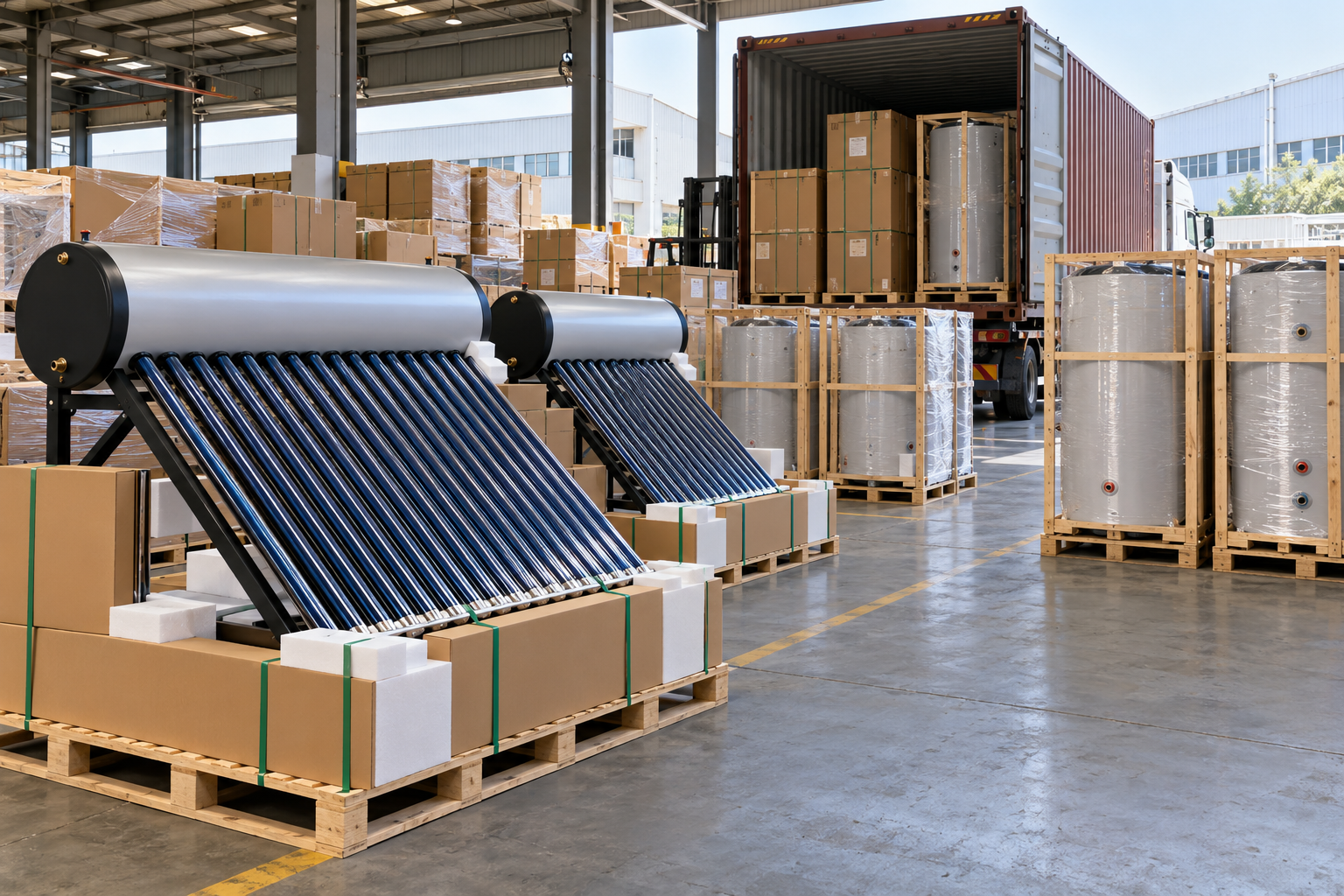
Millionsun is a source factory in Dongguan, China, producing flat plate collectors, solar water tanks and system accessories since 2006. We supply complete systems, SKD, CKD or components, with OEM and ODM options for logo, labels, packaging, coating colour, collector and tank size and technical documentation. Tell us your climate, roof type and volume, and we will propose a range.
Frequently Asked Questions
Is a thermosyphon or a split solar water heater better?
A thermosyphon solar water heater is better in warm climates with roofs that can carry a tank, and a split solar water heater is better in frost-prone climates or where the roof cannot carry a tank. Neither type is better in every case, so match the type to freeze risk, roof structure and installer skill.
Does a thermosyphon solar water heater need electricity?
A thermosyphon solar water heater does not need electricity to circulate water, because gravity moves the water between collector and tank. FSEC-EN-9 states that a thermosiphon system requires neither pump nor controller. Electric backup in the tank is optional and uses electricity only when it is switched on.
Can a thermosyphon solar water heater work in freezing weather?
A thermosyphon solar water heater can work in freezing weather only if frost protection is built in, such as a freeze valve, an indirect antifreeze loop or a drain-down arrangement. Without protection, water in the collector can freeze and damage it, so confirm the supplier’s frost design for your market.
Why are split solar water heaters more expensive?
Split solar water heaters cost more because they add a pump station, controller, sensors, expansion vessel and a longer pipe run to the same collectors and tank. Installation also takes more time and skill. The extra cost buys freedom in tank location and better frost design.
Can one distributor sell both thermosyphon and split systems?
Yes, one distributor can sell both thermosyphon and split systems, and sharing the same collectors and tanks keeps stock simple. Start with the type your climate favours, and add the second type for premium projects once your installers are trained.
Bottom Line
- Thermosyphon: tank above the collector, no pump or controller, best for warm markets and roofs that can carry the tank.
- Split: pump, controller and an indoor tank, best for frost, weak roofs and projects that need design freedom.
- Climate decides first: indirect systems prevail in cold regions, direct systems where freezing is not a risk.
- Ask for system and collector test reports under EN 12976 and ISO 9806, and compare parts lists before prices.