 跳至内容

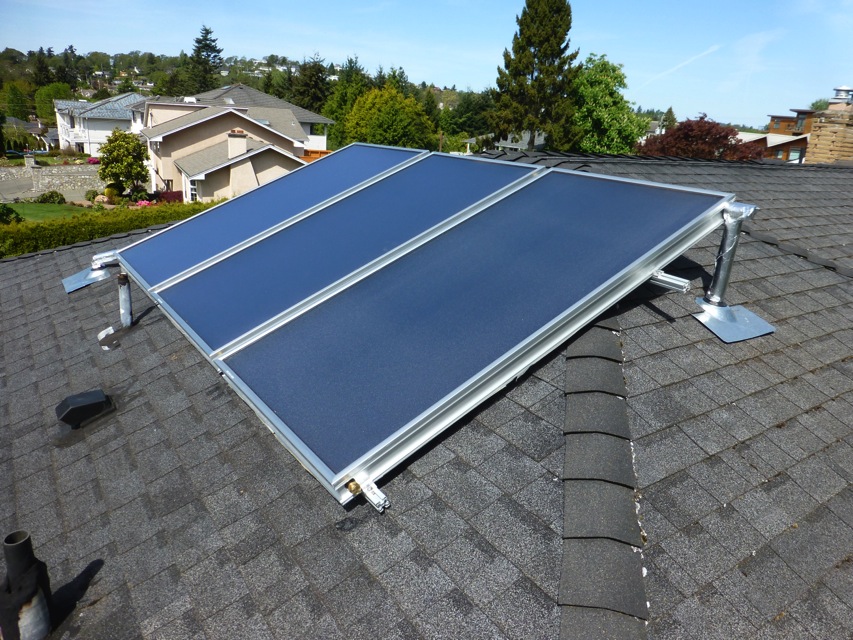
A split system puts the collectors on the roof and the tank indoors, joined by a pumped loop and a controller. That one design choice decides freeze protection, roof load and how the system looks, and it puts more of the outcome in the installer’s hands.
Short answer: A solar hot water split system separates roof-mounted flat plate collectors from an indoor storage tank and moves heat between them with a pump, a differential temperature controller and, in most markets, a closed glycol loop with a heat exchanger in the tank. Specify one when the roof cannot carry a tank, when freezing is possible, or when the tank must sit near the point of use.
Key Takeaways
- Six core parts: collectors, insulated pipework, pump station, differential controller, expansion vessel and an indoor tank with a coil.
- Published settings start the pump at an 8–20 °F (4–11 K) collector-over-tank difference and stop it at about 3–5 °F (2–3 K).
- Glycol loops protect against freezing; drain-back loops protect against freezing and overheating but need more pump head and continuous pipe falls.
- The pipework usually holds more loop fluid than the collectors, so measure the run before ordering glycol or sizing the expansion vessel.
What Is a Split Solar Water Heating System?
A split solar water heating system is a pumped (forced circulation) system in which the collectors and the storage tank are installed apart, usually collectors on the roof and tank in a plant room, garage or utility space. A pump moves fluid through the collectors only when the collectors are hotter than the tank, and a controller makes that decision from two temperature sensors.
Most split systems are indirect, meaning the collector loop is a separate circuit from the drinking water. The Florida Solar Energy Center’s guide FSEC-EN-9 describes the indirect layout as an antifreeze solution circulating through the collector while a heat exchanger coil in the lower half of the storage tank transfers the heat to the potable water. A direct split system pumps potable water through the collectors instead, which is simpler but only suits climates without frost.
The split layout trades simplicity for flexibility: a thermosyphon system needs no pump because its tank sits above the collector on the roof, while a split system frees the tank location at the cost of more parts to install and service.
Which Components Make Up a Split System?
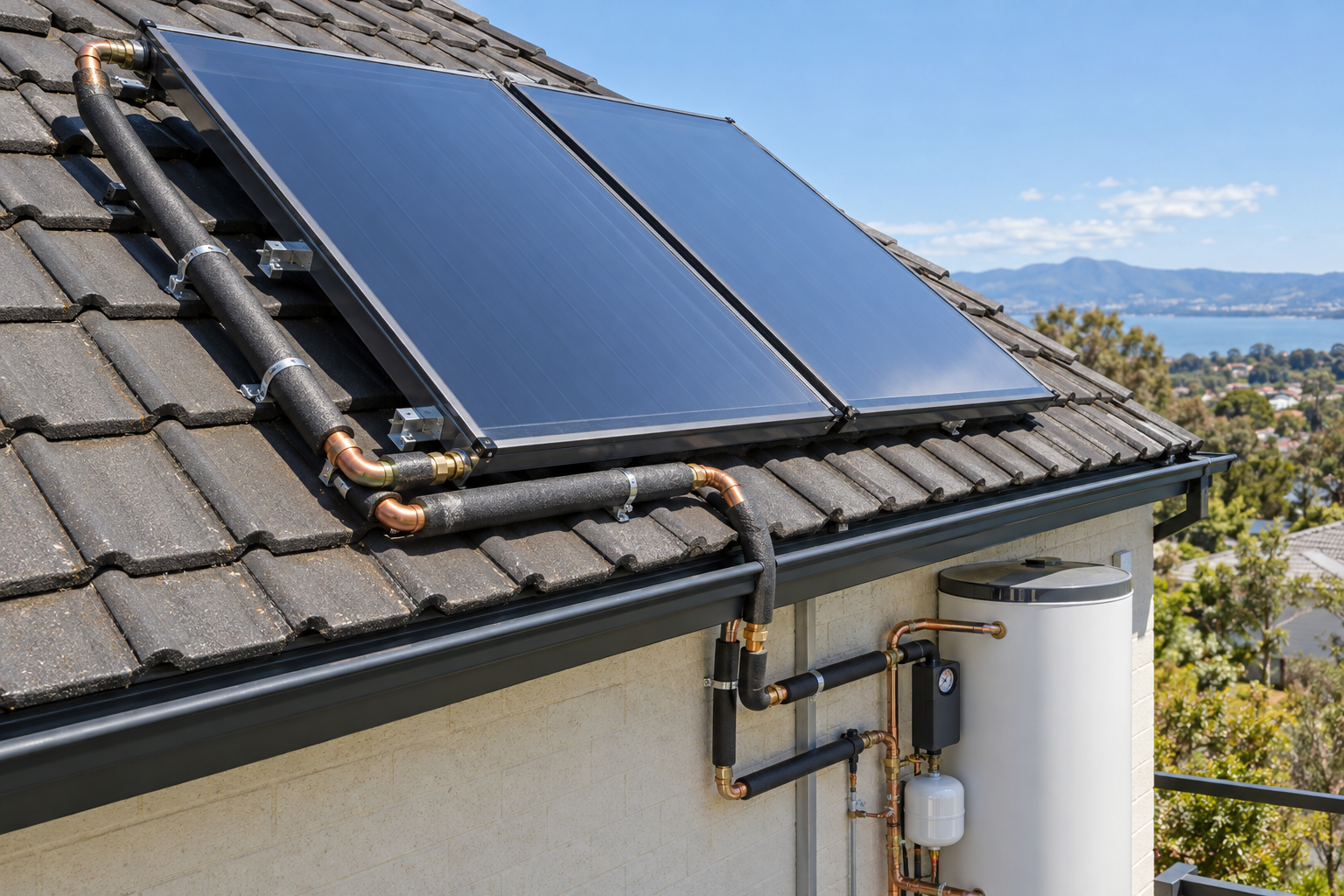
A split system has six core components, and each one has a single job that a buyer can check on a datasheet:
| Component | Job in the system | What to check when specifying |
|---|---|---|
| Flat plate collectors | Absorb solar radiation and heat the loop fluid | ISO 9806 test report, operating and test pressure, stagnation temperature, connection size |
| Flow and return pipework | Carry fluid between roof and tank | Pipe size, UV-resistant high-temperature insulation, run length |
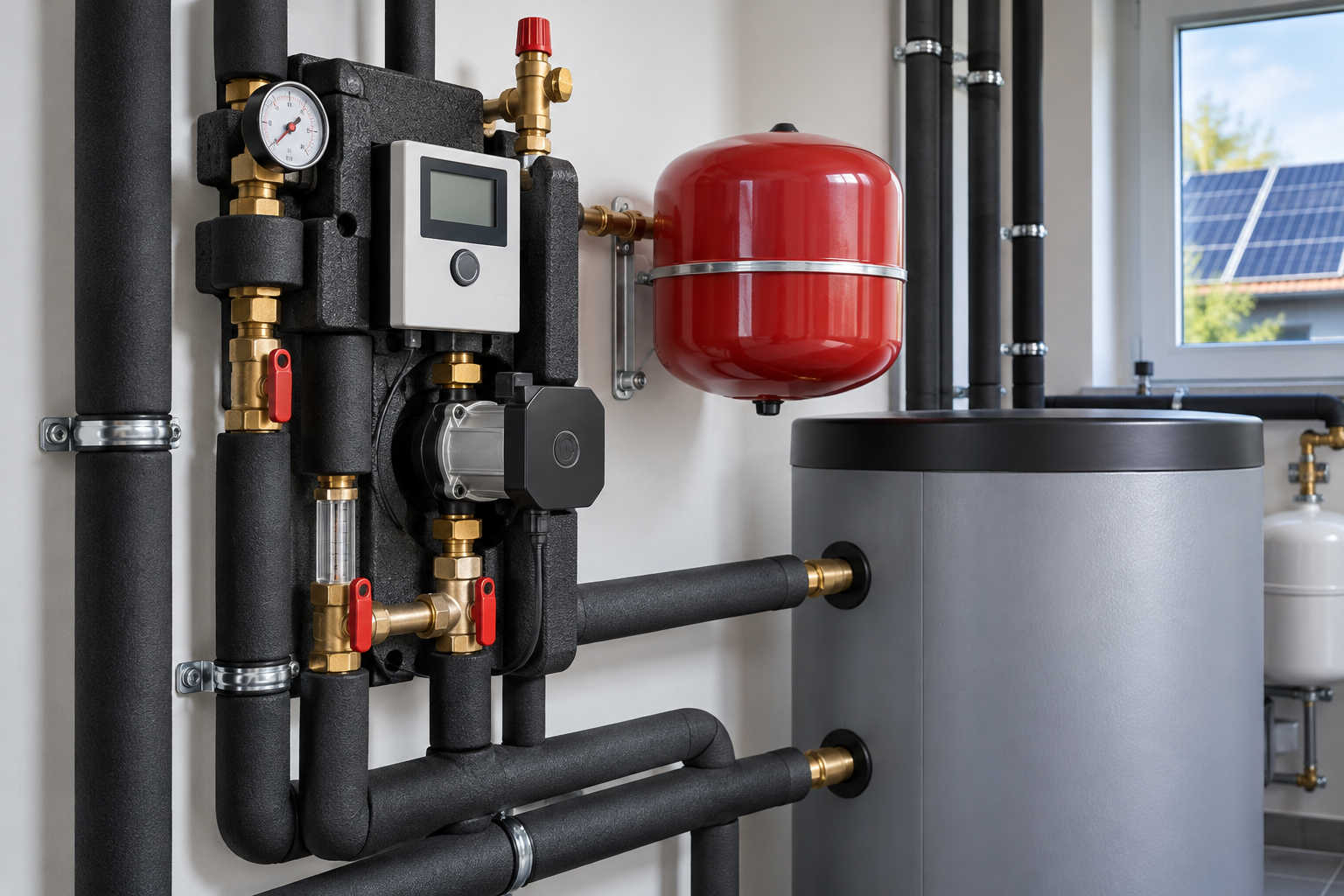
| Pump station | Circulates fluid; usually groups pump, check valve, pressure gauge, safety valve and fill/drain points | Pump head for the pipe run, safety valve rating, flow indicator |
| Differential controller | Starts and stops the pump from collector and tank temperatures | Adjustable on/off differentials, collector over-temperature function, backup heater output |
| Expansion vessel | Absorbs fluid expansion, including steam volume during stagnation | Volume, pre-charge pressure, maximum operating pressure and temperature |
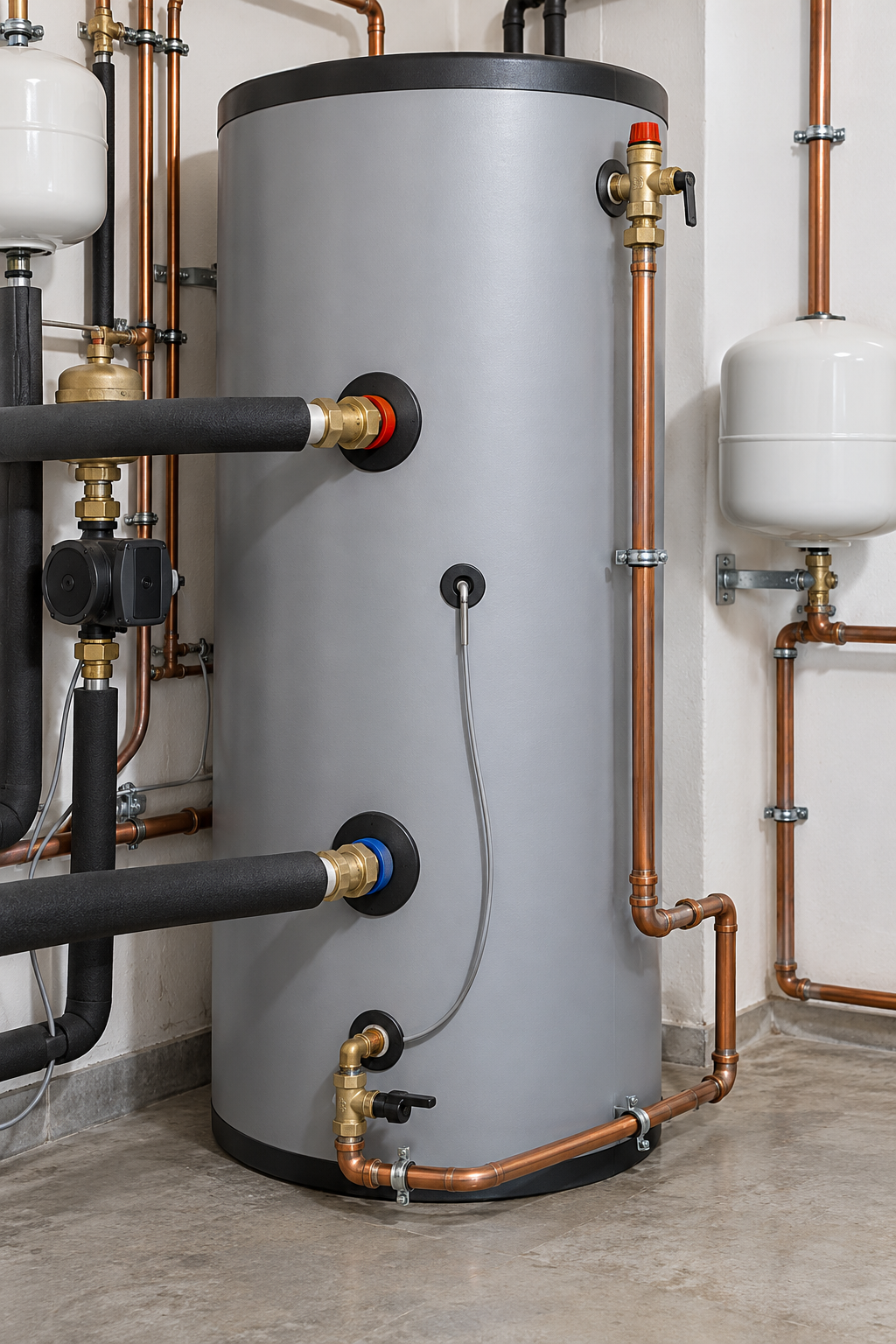
| Storage tank with coil | Stores heated water; coil keeps glycol and potable water separate | Working and test pressure, coil position, sensor pocket, TP valve, heat loss |
The pump station is best bought as one pre-assembled unit. The US Department of Energy’s PNNL O&M best practices guide notes that the pump in an active system is usually part of a pump station attached to or integrated with the tank, which removes field joints and puts the gauge and fill points where technicians expect them.
Buying all six components from one supplier is the cleanest way to avoid mismatched ratings. Collector, safety valve, expansion vessel and tank coil ratings have to agree, and a matched kit such as our split solar water heating system is pressure-rated as one circuit.
How Should the Differential Controller Be Set?
The differential controller should start the pump when the collector is clearly hotter than the bottom of the tank and stop it before the pump starts moving heat the wrong way. FSEC-EN-9 gives a turn-on point of about 15–20 °F (8–11 K) collector over tank and a turn-off point of about 3–5 °F (2–3 K). The Building America Solution Center’s drain-back guide cites a typical turn-on differential of 8 °F (about 4.4 K).
The gap between turn-on and turn-off is what stops the pump from short-cycling. A turn-on differential set too close to the turn-off point lets cold fluid from a long pipe run reach the tank sensor, drop the difference and stop the pump seconds after it started. Longer pipe runs and larger pipe volumes justify the upper end of the turn-on range.
Sensor position matters as much as the setting. Building America places one sensor at the collector outlet and one at the bottom of the storage tank, and the tank sensor belongs in a dry pocket level with the bottom of the solar coil. A tank sensor mounted too high reads backup-heated water and keeps the pump off on good solar days.
How Do Split Systems Handle Freeze and Overheat Protection?
Split systems handle freezing in one of three ways — a closed glycol loop, a drain-back loop or, in frost-free climates only, a direct loop — and the choice sets the hydraulic design. PNNL states that freezing climates require either antifreeze or seasonal shutdown and draining, that indirect antifreeze systems are very common there, and that propylene glycol and water is the most common mixture because ethylene glycol is toxic.
| Protection method | How it works | Strengths | Watch-outs |
|---|---|---|---|
| Closed glycol loop (indirect) | Propylene glycol mixture stays in a pressurised loop; coil transfers heat to tank | Works in any climate; pipe falls not critical; standard pump stations | Fluid ages under repeated stagnation; needs expansion vessel and periodic freeze-point and pH tests |
| Drain-back loop | Fluid drains into a reservoir whenever the pump stops | Protects against freezing and overheating; collectors empty during stagnation | Needs continuous pipe falls and more pump head at start-up; fluid level must be checked |
| Direct loop | Potable water pumped through collectors | No heat exchanger or glycol | Frost-free climates only; scale in hard water; collectors see mains pressure |
Glycol loops are the usual choice for split systems because they tolerate imperfect pipe routing. The fluid needs to suit solar duty: the technical sheet for TYFOCOR LS, a ready-mixed propylene glycol solar fluid, gives frost protection to −28 °C and a pH of 9.0 to 10.5, values the installer can test against at every service.
Drain-back loops solve overheating as well as freezing, at the cost of stricter installation. Building America describes an unpressurised reservoir of 10–20 gallons (about 40–75 litres) that holds all loop fluid by gravity when the pump stops, and notes the extra pump head needed at start-up.
Overheat protection in a glycol loop comes from the controller and the expansion vessel. When the tank is full of heat the pump stops and the collectors stagnate, reaching 152 °C on Millionsun’s standard flat plate collectors, and the vessel must absorb the fluid displaced as steam forms.
How Do You Size the Solar Loop, Glycol Charge and Expansion Vessel?
Size the loop from its total fluid volume, and on most split jobs the pipework holds more fluid than the collectors do. Flat plate collectors with harp absorbers carry very little fluid: Millionsun’s standard collectors hold 1.2 litres at 1.5 m² gross area, 1.6 litres at 2.0 m², 2.0 litres at 2.5 m² and 2.4 litres at 3.0 m².
An illustrative calculation shows the proportions. Four 2.5 m² collectors hold 8 litres. A 22 mm copper pipe has a bore of roughly 20 mm and holds about 0.3 litres per metre, so a 20-metre route from roof to plant room, run as flow and return, adds about 12 litres. Add the coil volume from the tank datasheet and the pump station volume, and the pipework is already the largest share of the charge.
- Glycol charge. Order total loop volume plus a margin for filling, flushing and post-repair top-ups.
- Expansion vessel. Size it for thermal expansion of the full loop volume plus the collector and nearby pipe volume that can turn to steam at stagnation, following the vessel and pump station manufacturer’s method.
- Pump. Check pump head against the full pipe run and the collector array’s pressure drop, and add the static lift for a drain-back design.
- Pipe insulation. Use insulation rated for stagnation temperatures on the collector side and UV-resistant cladding outdoors.
Pressure ratings should be read as one chain. Our flat plate collectors are rated at 12 bar operating and 20 bar test pressure, and our split system works at 7 bar, so the loop safety valve and expansion vessel must be chosen below the weakest component in the circuit, not the strongest.
When Should You Specify a Split System Instead of a Thermosyphon?
Specify a split system when the roof, the climate or the building layout rules out a roof-mounted tank; otherwise a thermosyphon system is usually simpler and cheaper to install. Thermosyphon systems remain the global majority: the IEA Solar Heating and Cooling Programme reports that they account for more than half of total installed solar thermal capacity worldwide (status end of 2022), and that indirect systems are prevalent in colder climates such as Europe, Japan and northern China.
| Decision factor | Split (pumped) system | Thermosyphon system |
|---|---|---|
| Tank location | Indoors, anywhere within pumping distance | On the roof, above the collector |
| Roof load | Collectors and frames only | Collectors plus a full tank of water |
| Frost climates | Suited, with glycol or drain-back | Needs an indirect design and has limits in hard frost |
| Electricity and controls | Pump and controller required | None for circulation |
| Installation skill | Plumbing, controls and commissioning | Mainly mechanical mounting and connection |
| Appearance | Low-profile collectors only | Visible tank on the roof |
Distributors usually need both product lines, because the climate and building stock split the market. Warm markets with flat roofs and no frost buy mainly thermosyphon solar water heaters, while cold-winter markets, tiled pitched roofs and multi-storey buildings push installers toward split systems.
Which Certifications Apply to Split Systems?
Split systems are certified at two levels, the collector and the system, and buyers should ask for both. In Europe, the Solar Keymark scheme listed by Eurovent Certification covers solar collectors tested to EN 12975 or ISO 9806, and solar systems tested to EN 12976 (factory-made systems) or EN 12977 (custom-built systems).
A fixed kit is typically assessed as a factory-made system, while a system designed project by project is custom-built. Other markets run their own schemes; our guide to solar collector certification by market sets out which documents each one asks for.
How Millionsun Supplies Split Systems
Millionsun supplies split systems as matched kits built around its own flat plate collectors and storage tanks, so the pressure chain is designed in rather than assembled on site. Our standard black flat plate solar collectors come in 1.5 to 3 m² sizes with 3.2 mm low-iron patterned tempered glass at 92% transmission or better, Φ22 copper headers and standardised 22 mm connections, and an empty weight of 24 to 38 kg depending on size.
The storage side is rated for pressurised duty. Our tanks work at 0.7 MPa with a 1.2 MPa test pressure, carry a TP valve and an air valve, are specified at 3 °C or less daily heat loss, take an optional copper coil for indirect loops and carry a 5-year warranty. Aluminium alloy frames cover tilt angles from 15° to 60°.
Every collector and tank is 100% pressure-tested before shipment and carries a traceable serial number. Controllers, pump stations, valves and expansion vessels come from our solar thermal accessories range; sensors and controllers ship as spares in 5 to 7 working days.
Both collector and system certification are on record. Our collectors obtained Solar Keymark in 2008, with collectors and systems listed again in 2011, the year we also obtained SRCC, WaterMark and AS/NZS 2712; certificate numbers come with the quotation. Our installer and service provider page covers first-installation support.
Building a split system range for your market?
Millionsun is a source factory in Dongguan, China, producing flat plate collectors, solar water tanks and system accessories since 2006. We supply complete systems, SKD, CKD or components, with OEM and ODM options for logo, labels, packaging, coating colour, collector and tank size and technical documentation. Send us your climate, roof type and target tank sizes and we’ll reply within 24 hours with a matched configuration and the certificates for your market.
Frequently Asked Questions
Does a solar hot water split system need electricity?
Yes, a solar hot water split system needs electricity to run its circulation pump and controller. The pump only runs when the collector is hotter than the tank, so its consumption is small next to the backup heater.
How far can the tank be from the collectors in a split system?
The tank in a split system can be as far from the collectors as the pump head and heat loss allow, so there is no single fixed limit. Each extra metre adds pipe volume, glycol, pressure drop and heat loss, so keep the route short, insulate it fully and check the pump curve against the actual run.
How often does the glycol in a split system need replacing?
The glycol in a split system should be replaced when testing shows it has degraded, not on a fixed calendar. Check freeze point with a refractometer and pH at every service visit and compare them with the fluid’s datasheet; repeated stagnation is the main thing that shortens fluid life.
Can a split system use a drain-back design instead of glycol?
Yes, a split system can use a drain-back design instead of glycol if the pipework can fall continuously back to the reservoir. Drain-back protects against both freezing and overheating, but it needs a pump sized for start-up lift and an installer who can guarantee the pipe falls.
Bottom Line
- A split system moves the tank indoors and adds a pump station, controller and expansion vessel; specify it when the roof, frost or building layout rules out a roof tank.
- Set the controller with a clear gap between turn-on and turn-off differentials, and put the tank sensor level with the bottom of the solar coil.
- Choose glycol for routing tolerance or drain-back for overheat protection, and measure the pipe run before ordering fluid or sizing the expansion vessel.
- Ask for collector and system certification, and buy the pressure-rated parts as one matched kit.