 跳至内容

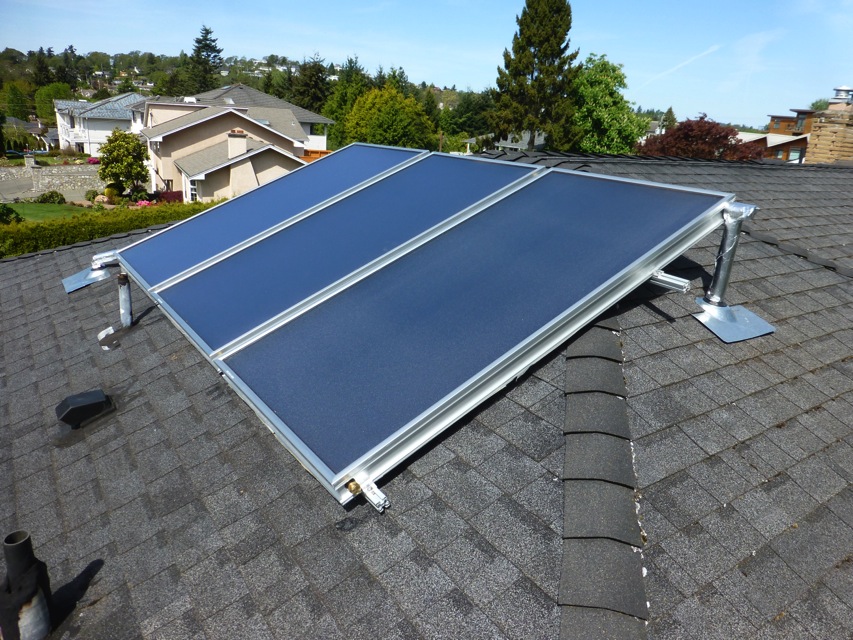
Commercial solar thermal systems fail quietly: nothing stops working, the backup boiler just carries more of the load while the bill creeps back up. A published service schedule prevents that, and it is what distributors and EPC contractors are asked to supply at handover.
Short answer: A commercial flat plate solar hot water system needs monthly visual and meter checks by site staff, one technician service visit a year, and a deeper inspection of fixings and mountings every two years. The annual visit covers loop pressure, pump and sensor operation, expansion vessel pre-charge, heat transfer fluid condition and the storage tank. Water safety temperature monitoring runs separately and more often.
Key Takeaways
- UK MCS standard MIS 3001 suggests monthly owner checks, annual intermediate service and a full service every two years for commercial systems.
- Annual O&M cost runs roughly 0.5% to 2% of installed cost, per the US DOE’s Pacific Northwest National Laboratory.
- Replace the heat transfer fluid on condition, not on a calendar: test freeze point and pH at every service against the datasheet values.
- Legionella monitoring is a separate, more frequent schedule — UK HSE guidance calls for monthly temperature checks at sentinel outlets and the calorifier.
- Stock sensors, controllers, seals and glycol before the first season. Sensors and controllers most often strand a system.
What Is the Standard Service Interval for a Commercial Solar Thermal System?
Commercial and industrial solar heating systems should get monthly owner checks, an intermediate service visit once a year and a full service visit every two years. Those intervals come from Appendix E of MCS standard MIS 3001, the UK installation standard for solar heating, which sets out an example maintenance schedule by building type and occupancy. The standard labels the frequencies advisory and notes that larger systems may justify more frequent visits.
Commercial buildings sit at the demanding end of that schedule because the cost of an unnoticed fault is higher. A domestic system that loses its pump wastes a few hundred kilowatt-hours a year; a hotel or factory array that loses its pump pushes the whole load onto the boiler, usually unnoticed until the gas bill arrives.
| Building type | Owner / staff checks (visual) | Intermediate service | Full service |
|---|---|---|---|
| Commercial and industrial | Monthly | 1 year | 2 years |
| Public building (school, hospital) | 6-monthly | 1 year | 5 years |
| Domestic rented | — | 2 years | 10 years |
| Domestic privately owned | 1 year | 2 years | 15 years |
A second, more granular schedule comes from the US Department of Energy. The Pacific Northwest National Laboratory O&M best practices guide splits solar water heating tasks into daily, weekly, monthly, quarterly and annual groups, and states that all such systems should be checked at least twice per year. Sites without maintenance staff fold the weekly items into remote controller monitoring.
What Should Be Checked Every Month?
The monthly check is visual and desk-based, and nobody needs to go on the roof. Six items catch the two failure modes that cost the most, a stopped pump and weather damage:
- Collectors from ground level. Slipped panels, cracked glass, heavy soiling, signs of structural distress after snow or storms.
- Pump station. Fault indications, leaks and staining around the pump, valves and fittings.
- Recorded generation. Confirm it is increasing and no fault codes are showing. A flat generation curve in a sunny week is the clearest early warning you get.
- Loop pressure gauge. Log the reading. A slow decline means a leak or a failing expansion vessel.
- Shading. Cut back vegetation and note new construction near the array.
- Pipework insulation. External insulation degraded by UV or pulled apart by birds is a common, expensive source of heat loss.
Recording the readings matters as much as taking them. A dated log turns a vague complaint into an evidenced warranty claim.

What Does the Annual Service Cover?
The annual service is a technician visit with instruments, covering the hydraulics, the controls and the fluid. It is where measured values replace impressions.
MCS MIS 3001 lists these items for an intermediate service visit: anti-legionella control is operational; the controller is set to maximise solar generation; the heat transfer fluid’s life has not expired and it passes checks for chemical stability, content and level; pressure and sensing devices function; pipework shows no corrosion; labels are updated; expansion vessel pre-charge is checked and the system is pressurised; documentation is intact.
PNNL adds the items larger systems need annually: electrical connections and, on three-phase pumps, power balance and voltage; cleaning the pump, strainer and controls and lubricating the motor; draining and flushing the storage and expansion tanks; and replacing the storage tank’s sacrificial anode.
The two-year full service goes to the roof. MIS 3001 adds torque checks on a random sample of collector clamps and fixings, confirmation that mounting rails are secure and undistorted, and a check that the fixings have not damaged the roof’s weatherproof layer. Our mounting frames are set between 15° and 60°, and that interface transfers wind load into the building, so it earns the sample torque check.

How Often Does the Heat Transfer Fluid Need Replacing?
Replace the heat transfer fluid on condition rather than on a fixed interval, and test it at every service visit. Two measurements decide it: freeze point, taken with a refractometer, and pH, both compared against the fluid manufacturer’s datasheet.
Datasheet values give you the pass criteria. The technical information sheet for Tyfocor LS, a propylene glycol fluid formulated for solar thermal duty, specifies a pH of 9.0 to 10.5 at 20 °C and frost protection to −28 °C as supplied. The alkaline reserve in fresh fluid is what protects copper, aluminium and steel in the loop; as inhibitors deplete, pH drifts toward neutral, and an acidic fluid attacks the metals it was meant to protect.
Stagnation is the main thing that ages the fluid. When the tank is fully charged and the pump stops on a clear summer day, collector temperature climbs to its idle maximum; on Millionsun’s standard black and blue flat plate collectors that figure is 152 °C. Flat plate collectors are gentler on glycol than evacuated tubes for this reason, but repeated stagnation cycles still shorten fluid life.
Collector durability under these conditions is what the type-test is for. The IEA SHC guide to ISO 9806:2017 lists the durability clauses a certified collector has passed, including the Exposure Test, Standard Stagnation Temperature determination, thermal shock tests, Freeze Resistance Test and Internal Pressure Test. Ask for the test report when you specify: it records what the collector survived.
What Maintenance Does the Storage Tank and Hydraulic Circuit Need?
The storage tank needs an annual internal check, anode replacement where fitted, and a protection-valve test. PNNL places tank integrity and insulation checks on a quarterly cycle, with draining, flushing and anode replacement annually, and adds a quarterly scaling inspection in hard water areas.
Pressure ratings set the test criteria, so they belong in the service record. Millionsun solar water tanks are rated at 0.7 MPa working pressure with a 1.2 MPa test pressure, and ship with a TP valve and an air valve as standard. Checking that the TP valve is not stuck and the air valve still vents takes a minute and prevents the two failure modes that damage tanks outright.
Water quality drives most of the tank workload. Hard water scales heat exchange surfaces and electric elements first, showing up as a slow drop in delivered temperature rather than a fault code. Our tanks use SUS304 or SUS316L inner tanks with an optional copper coil, and that coil is the surface to inspect in a scaling market. Insulation is worth logging too: our tanks are specified at a daily heat loss of 3 °C or less, so a larger overnight drop points to insulation damage or a failed check valve. On large capacity solar water tanks for 1,000 to 5,000 litre preheat duty, inspection access has to be designed in before the plant room is closed up.
How Does Legionella Control Change the Schedule?
Legionella control is a separate schedule that runs more often than solar servicing, and in most markets it is a legal duty rather than a maintenance option. UK HSE guidance HSG274 Part 2 is the clearest published reference for the commercial case. Calorifier flow thermostats should modulate as close to 60 °C as practicable without going below 60 °C, and return temperatures should not fall below 50 °C, both checked monthly. At sentinel outlets — the nearest and furthest taps plus long branches — hot water should reach at least 50 °C within one minute, or 55 °C in healthcare premises. Calorifiers are inspected internally once a year.
Solar storage is a preheat stage, not the final calorifier, and the distinction matters for compliance. The solar tank can sit well below 60 °C for much of the year, which is normal and is why the backup heater finishes every litre at the temperature the water safety plan requires. Design the hydraulics with no dead legs, drain points and sensor pockets for pasteurisation control, and the solar stage adds no new water safety problem.
What Does Annual Maintenance Cost, and Which Spares Should Be on the Shelf?
Budget roughly 0.5% to 2% of installed system cost per year for operations and maintenance. That range comes from PNNL’s O&M best practices guide and covers labour and consumables; it excludes major component replacement and the cost of lost production on a system nobody is watching.
PNNL also publishes typical industry warranty bands: 5 to 10 years on collectors, 3 to 5 years on storage tanks and 1 to 2 years on other components. The shortest-warranty components are the ones to stock first.
Sensors, seals, pump parts and glycol cover almost all unplanned commercial call-outs:
- Sensors and controllers. These strand systems most often, because a failed collector sensor usually stops the pump entirely.
- Seals, gaskets and connector fittings. Cheap, small, and the reason a technician makes a second visit.
- Pump and pump station parts. The longest replacement lead time if not stocked regionally.
- Heat transfer fluid. Enough to top up after a repair, plus a refractometer and pH strips so testing happens.
Lead times decide how much you stock. Millionsun ships gasket and seal kits and connector fittings within 3 to 5 working days, sensors and controllers within 5 to 7 working days, and holds spare parts for the full product lifespan. Our solar thermal accessories range covers controllers, pump stations, valves, expansion vessels and mounting hardware, letting distributors stock one compatible set instead of mixing brands across a fleet.
How Millionsun Handles This
Millionsun builds the service record into the product so field maintenance has something to work from. Every collector carries a unique serial number linked to its batch, production date, QC records, materials and shipment destination, so a fault reported five years in can be traced to a production run rather than argued about.
Factory testing sets the baseline a technician measures against. Every collector and every tank is 100% pressure-tested before shipment. Our standard flat plate collectors are rated at 12 bar operating and 20 bar test pressure, with a 3.2 mm low-iron patterned tempered glass cover at 92% transmission or better, EPDM and silicone seals, a 6063 aluminium alloy frame and 30 mm glass wool at 35 kg/m³. Headers are Φ22 copper with standardised 22 mm connections, so replacement units from a later production year still fit an existing array.
Warranty terms are confirmed per product and per market on the quotation rather than quoted as one figure, because they differ by product line and destination market scheme. Ask for them in writing with the offer, along with the certificate references for your market.
Supply format affects maintenance more than most buyers expect. Millionsun supplies complete units, SKD, CKD or components, and companies that assemble locally hold component stock anyway, which doubles as a spares pool. Founded in 2006 in Dongguan, China, we reply to technical and spare parts enquiries within 24 hours. For the pre-shipment side of quality, see our factory quality control checklist; our installer and service provider page and EPC and project developer page cover after-sales support.

Need a service schedule and spares list for a project?
Millionsun is a source factory in Dongguan, China, supplying flat plate collectors, solar water tanks and accessories as complete units, SKD, CKD or components, with OEM and ODM support. Send us the system configuration and we’ll reply within 24 hours with a maintenance schedule, a spares list and the certification documents for your market.
Request a QuoteFrequently Asked Questions
Who should carry out the annual solar thermal service?
The annual solar thermal service should be carried out by a technician trained on pressurised solar loops, not a general plumber. The work involves expansion vessel pre-charge, refractometer and pH testing of the heat transfer fluid, and controller configuration — all three are routinely got wrong by people who treat the system as a boiler circuit.
What happens if a commercial solar hot water system is never maintained?
An unmaintained commercial solar hot water system keeps delivering hot water while quietly delivering less and less solar energy. The usual sequence is a slow loss of loop pressure, air in the collectors, a pump running against an airlock, then a glycol charge with no freeze protection left. Nothing fails visibly, so the backup heater absorbs the load and the saving disappears.
Do flat plate solar collectors need to be cleaned?
Flat plate solar collectors rarely need routine cleaning, because rainfall removes most soiling from glass mounted at 15° or steeper. PNNL lists panel washing with mild detergent and a soft brush as an as-needed task, not a scheduled one. Dusty, agricultural and coastal sites belong on the quarterly cleanliness check.
Which spare parts should a distributor stock for a solar water heater fleet?
A distributor should stock collector and tank sensors, controllers, seal and gasket kits, connector fittings, a pump or pump station, and heat transfer fluid. Sensors and controllers cause the most dead systems per unit cost, and standardising on one accessory range keeps the stock list short.
Does a heat pipe flat plate collector need different maintenance?
A heat pipe flat plate collector follows the same service schedule but has different pressure and temperature limits, so its test values differ from a standard harp collector. Use the specification sheet for the model actually installed: operating pressure, test pressure and stagnation temperature are not interchangeable between collector types.
Bottom Line
- Write the schedule into the handover pack: monthly staff checks, annual technician service, two-yearly roof and fixing inspection.
- Measure rather than inspect at the annual visit — loop pressure, expansion vessel pre-charge, sensor readings, glycol freeze point and pH.
- Keep Legionella monitoring on its own monthly schedule, and treat solar storage as a preheat stage the backup heater always finishes.
- Stock sensors, controllers, seals and glycol before the first season, and budget 0.5–2% of installed cost per year for O&M.